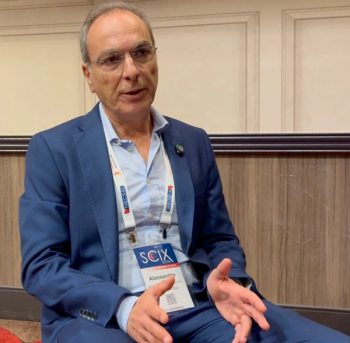
At SciX, Kevin Wilkinson of the Universite de Montreal explains how faster data acquisition and new software have cut analysis time and how a particle’s chemical composition can link arsenic-bearing emissions back to a copper refinery’s processes.
A preview of the conference to be held in Baltimore, Maryland, April 23–27, 2012
At a time when security concerns are increasing around the world, the International Society for Optical Engineering (SPIE) presents the 2012 Defense, Security, and Sensing conference to offer timely material and research to help countries keep up to date with the latest tools and methods for security applications, as well as for environmental sensing. This year's conference will be held April 23–27 at the Baltimore Convention Center in Baltimore, Maryland.
(Jose Luis Stephens/GettyImages)
Conferences
This conference features a unique setup compared to other conferences in that various topics are grouped into their own conference program tracks based on related technology topics. The program tracks include the following topics:
Courses
Another feature of the 2012 SPIE Defense, Security, and Sensing conference is the opportunity to meet with and learn from various industry experts and acquire skills you can apply to your daily work, through several courses offered. This year's program features 12 new courses and workshops, including all-new content on energy harvesting, night vision, high dynamic range (HDR) imaging, and international traffic in arms regulations (ITAR) and international trade.
Course registration includes the selected course, course notes, coffee breaks, and admittance to the exhibition. The course listings are available on the SPIE website under the various program tracks (
Exhibition
A conference exhibition is a great place for users to meet face-to-face with their suppliers or see new instrumentation that has become available. The 2012 SPIE Defense, Security, and Sensing exhibition is one of the biggest in this industry, with more than 500 companies expected on the show floor. Featured technologies include chemical and biological sensing; infrared sources, detectors, and systems; lasers and other light sources, laser accessories, and laser systems; cameras and CCD components; displays; electronic imaging and fiber-optic components, equipment, and systems; optical components, including specialized lenses and coating; high-speed imaging and sensing; high-precision optics manufacturing; nanotechnology applications; law enforcement technologies; robotics and unmanned systems; and new technology demos and displays. The exhibit floor with be open Tuesday, April 24 from 9:30 a.m. to 5:00 p.m.; Wednesday, April 25 from 10:00 a.m. to 5:00 p.m.; and Thursday, April 26 from 10:00 a.m. to 2:00 p.m.
Technical Program and Special Events
The 2012 SPIE Defense, Security, and Sensing conference will feature distinguished plenary speakers, workshops, panel discussions, poster receptions, and more. All conferees are welcome to attend the welcome reception on Monday, April 24 from 6:30 to 8:00 p.m. at the Maryland Science Center. There will also be a presentation and reception on "Women in Optics" on Tuesday, April 25, from 5:00 to 6:30 p.m. and an "Early Career Networking Social" on Wednesday, April 26, from 5:00 to 6:30 p.m., which all conferees are welcome to attend. Other events might require tickets.
For more information on this conference, please visit the SPIE website:
almost 15 years ago
Short Coursesalmost 15 years ago
Productsalmost 15 years ago
Confocal Raman Microscopy in Forensic Pharmaceutical Investigationsalmost 15 years ago
Nanoscale IR Spectroscopy: AFM-IR — A New Techniquealmost 15 years ago
From the Editoralmost 15 years ago
Vol 27 No 2 Spectroscopy February 2012 Regular Issue PDFalmost 15 years ago
Terahertz Spectroscopy