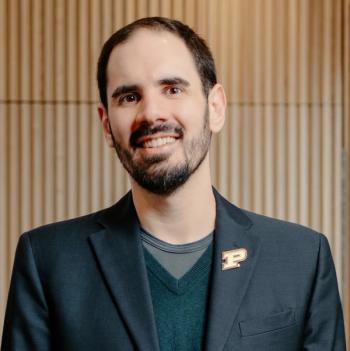
An upcoming talk at the 2026 SciX Conference will focus on nanoplastic analysis to distinguish between plastic and non-plastic particles.
Patrick Parsons of the New York State Department of Health discusses how X-ray fluorescence (XRF) instruments can be used in food safety monitoring applications.
The second part of our interview with Patrick Parsons of the New York State Department of Health covered his study’s findings and compared different X-ray fluorescence (XRF) analyzers (1). In this interview clip, we asked Parsons about what his recent study’s (2) validation results mean for using the tested X-ray fluorescence (XRF) instruments as frontline screening tools for food safety monitoring.
Spectroscopy: The research highlights strong agreement between XRF-derived concentrations and CRM values for several toxic elements, as well as successful performance on FERN 2022 proficiency test samples. How do these validation results influence confidence in using these instruments as frontline screening tools for food safety monitoring?
Patrick Parsons: In our study that we published in Radiation Physics and Chemistry last year, we used a range of different certified reference materials, many of them from NIST, but we also had some others from a European Agency (ERM) and from the National Research Council (NRC) of Canada, and from Japan (NMIJ). These are all food reference materials, and they're certified for a range of elements at different concentrations. You need that broad selection in order to be able to validate the technology. What the manufacturer did was to take those materials and use the data from those materials to tweak the algorithm—the fundamental parameters algorithm—so that it delivered results that were as close as possible to the certified values. And they did extremely well with that.
What I would compare that to is this, you've got an instrument, you're calibrating it with calibration standards, and you're looking at predicted values. That's all well and good, but you need something a little independent of that to ensure that you're actually accurate and traceable to SI units. So, we were able to use some other materials. The FDA provided us with some proficiency testing materials, and while they're not primary reference materials, their characterization was pretty good. We were able to use those to cross validate the technology. I should point out that the materials that that they provided had already been analyzed with FDA methods, and so they were not blinded to us, but they were archived, and available. We had all of the characterization data. But be that as it may, we got quite reasonable data, in the tens of parts per billion levels on these different food matrices, and so that was really quite exciting.
This video clip is the third part of our conversation with Parsons as part of our coverage of the Winter Conference on Plasma Spectrochemistry. To stay up to date on our coverage of the Winter Conference on Plasma Spectrochemistry, click