
Webcasts
Webinar Date/Time: Wednesday, September 17, 2025 Morning Session: 10:00 AM EST | 7:00 AM PST | 3:00 PM BST | 4:00 PM CEST Afternoon Session: 1:00 PM EST | 10:00 AM PST | 6:00 PM BST | 7:00 PM CEST
Webcasts
Webinar Date/Time: Wednesday, September 17, 2025 Morning Session: 10:00 AM EST | 7:00 AM PST | 3:00 PM BST | 4:00 PM CEST Afternoon Session: 1:00 PM EST | 10:00 AM PST | 6:00 PM BST | 7:00 PM CEST

Sponsored Content
In this application note, we evaluate the use of 785 nm Raman analysis as a complement to UV-vis spectroscopy in analyzing proteins.
Sponsored Content
In this application note, we evaluate the effectiveness of a modular spectrometer for measuring the absorbance of optical filters and potassium dichromate standards.
Sponsored Content
Its high SNR and excellent thermal stability make the Ocean SR6 spectrometer desirable for applications including DNA analysis and protein concentration measurements.
Sponsored Content
In this application note, we use an Ocean ST-UV microspectrometer (185-650 nm) to measure the absorbance of whole blood and methemoglobin.
Sponsored Content
In this application note, a microspectrometer is evaluated as an option for measuring the fluorescence of the compounds Europium chloride and Terbium chloride.
Sponsored Content
Using modular Raman spectroscopy to monitor and optimize UV-cured epoxies applied during die-attach processes in semiconductor assembly.
Sponsored Content
Utilize absorbance spectroscopy to measure concentration levels of active pharmaceutical ingredients before and after Cleaning-in-Place processes.
Sponsored Content
Here, modular Raman spectroscopy is used to monitor and optimize UV-cured epoxies applied during die-attach processes in semiconductor assembly.
Sponsored Content
Spectrometer performance is indicated by criteria including optical resolution and stray light. In this tech tip, we consider dynamic range and signal to noise ratio.
Sponsored Content
Utilize absorbance spectroscopy to measure concentration levels of active pharmaceutical ingredients before and after cleaning-in-place processes.
Sponsored Content
Our smart chemical sensor can identify unknown molecules related to the wellness, health of tissues, illicit drugs, pharmaceuticals, medicine, food, and other materials.
Sponsored Content
SERS nanoparticles amplify weak Raman signals, enabling trace level detection of illicit drugs such as cocaine, heroin and methamphetamine.
Sponsored Content
We describe how a manufacturer of antimicrobial-impregnated catheters has traded HPLC for reflectance spectroscopy to streamline its quality control processes.
Application Notebook
Application Notebook

Special Issues
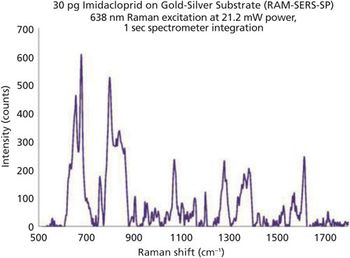
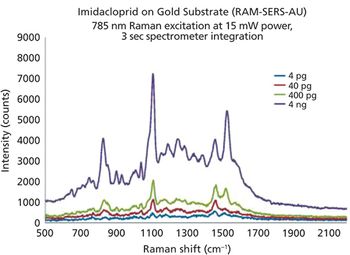
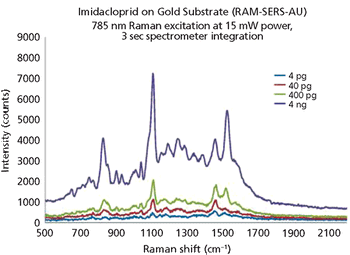
In this application note, we evaluate the effectiveness of surface enhanced Raman spectroscopy (SERS) to measure trace levels of imidacloprid, one of a class of insecticides linked to honeybee loss.
Application Notebook
Spectroscopy
Sponsored Content
Using modular spectroscopy, we calculate the color difference -- Delta E in the L*a*b* color space -- of Pantone® color guide samples compared with a color reference.
Sponsored Content
In this application note, we evaluate the effectiveness of surface enhanced Raman spectroscopy (SERS) to measure trace levels of imidacloprid, one of a class of insecticides linked to honeybee loss.
Application Notebook

Special Issues
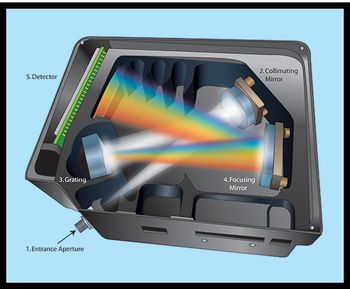
Raman spectroscopy offers a number of benefits for testing and characterization, with the selection of system components and measurement parameters offering great flexibility.
Spectroscopy
In this technical note we discuss the causes and consequences of stray light, and provide suggestions for mitigating its effects in your experimental setup.
Application Notebook
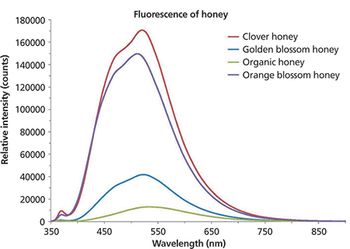
The flavonoids that dominate the fluorescence spectra for honey shown in Figure 1 are polyphenols. These plant metabolites determine the color, aroma, and flavor of the honey, and provide antioxidant and other health benefits. The fluorescence spectrum for each honey sample illustrates the sensitivity of fluorescence spectroscopy for characterizing honey.
Spectroscopy
In this application note, we focus on the peripheral artery disease (PAD) and its treatment, utilizing NeoFox optical oxygen sensor system to demonstrate how oxygenation increases stem cell survival and leads to improved therapeutic outcomes for PAD patients.
Application Notebook
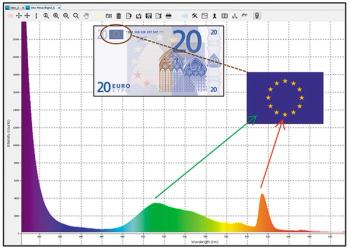
Inks and pigments with optically unique properties can provide quick visual verification of authenticity, and can be difficult to replicate.
Spectroscopy
Surface enhanced Raman spectroscopy (SERS) has expanded the applications of Raman spectroscopy to include trace analysis of materials such as explosives residues, evidence at crime scenes, chemical warfare agents and pesticides. As a label-free technique, SERS is also well suited to biosensing, from blood glucose to diagnosis of diseases like cancer, Alzheimer’s and Parkinson’s.
Spectroscopy
Gluten -- a substance found in grains – is an allergen for some people. When processing gluten-free and other grains, cross contamination is a risk. This article describes how NIR spectroscopy combines with machine vision for accurate sorting of glutenous grains.
September 1st 2014

December 1st 2014
February 1st 2015
April 20th 2015
June 12th 2015
August 11th 2015