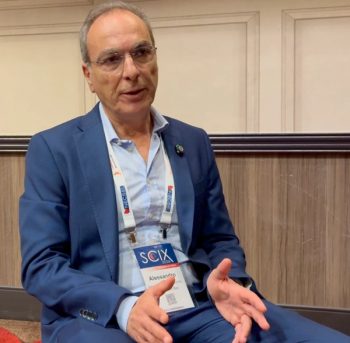
At SciX, Alessandro De Giacomo explains how a 35-member international jury chose three papers: one on correct ICCD use and two applications using LIBS and LA-ICP-MS. He also explains what the selections say about the field.
Jorge Caceres, a professor at Complutense University in Madrid, Spain, sat down with Spectroscopy to discuss how LIBS works as a fast, simple, cost-effective, and analytically conclusive technique for confidently re-associating human bone remains.
At the 2025 SciX Conference, Jorge Caceres, a professor at Complutense University in Madrid, Spain, delivered a talk that highlighted the growing evidence supporting laser-induced breakdown spectroscopy (LIBS) combined with supervised classification methods as a powerful solution for the individual reassignment of mixed or commingled bone remains (1,2). Because bone chemistry offers a distinct elemental signature for each individual, LIBS enables rapid ablation and spectral fingerprinting of microscopic bone sections without complex sample preparation (1).
Caceres discussed how high-quality identification depends on using advanced data-processing approaches. Recently, Caceres sat down with Spectroscopy to discuss these approaches and how LIBS works as a fast, simple, cost-effective, and analytically conclusive technique for confidently re-associating human bone remains.
Your study explores the use of laser-induced breakdown spectroscopy (LIBS) for the reassignment of mixed bone remains. What motivated you to apply LIBS to this type of forensic or archaeological challenge, and what advantages does it offer over traditional methods?
Initially, the idea arose from how we could contribute to solving cases of bone reassignment from mass graves, which are unfortunately common in many countries, such as those that occur in wars or because of political situations. We knew that we could classify samples efficiently using neural network-based algorithms. The results we obtained sparked the interest of archaeologists, who added to the challenge by proposing the study of bones from animals with the same diet or from fossils. The results in both cases were excellent. Furthermore, the studies led us to compare different classification algorithms, and the results showed that the neural networks we had developed performed the best.
Regarding the advantages LIBS technology offers over other methods, we can say that it allows the complete elemental profile of a sample to be obtained in seconds, requires minimal preparation, and avoids using reagents, reducing costs and analysis time. In addition, it can be applied directly to the material with virtually no prior preparation, and it generates accurate elemental fingerprints that facilitate reliable classifications. These characteristics make it a fast, versatile, and effective tool for the forensic study of bone remains. They are particularly useful in cases where there are many samples or where DNA cannot be extracted.
You mention that bone elemental composition can act as a unique individual identifier. Could you explain how variations in elemental makeup arise between individuals and how LIBS captures these differences effectively?
The elemental composition of bone varies between individuals because this tissue incorporates elements throughout life, influenced by factors such as diet, metabolism, age, sex, disease, drugs, and even the environment in which one lives or in which the remains are found after death. These processes modify the proportion of major components (such as Ca, P, and Mg) and also minor or trace elements (such as Sr, Zn, Fe, Cu, or Mn), generating a unique chemical pattern in each person.
LIBS effectively captures these differences because, with a single laser pulse, it produces a spectrum that simultaneously reflects all the atomic signals emitted by the elements present in the bone. This spectrum serves as a complete and specific elemental fingerprint of the individual, faithfully reproducing the actual distribution of elements within the tissue. The technique detects both abundant components and trace elements that contribute to variability between individuals, enabling individuals to be distinguished by their chemical signatures.
LIBS is known for generating elemental “fingerprints” through direct ablation of samples. What specific challenges did you face when applying LIBS to bone material, particularly in ensuring reproducible and representative spectra?
The application of LIBS to bone posed several challenges that had to be controlled to obtain reproducible, representative spectra. Bone surfaces vary in porosity, roughness, and compactness, which affects how the laser interacts with the material, and it can cause fluctuations in plasma formation and line intensity. To ensure uniform ablation, it was necessary to select stable surfaces and avoid fractured or highly porous areas.
Another difficulty was the intrinsic structural heterogeneity of bone. The proportions and distributions of its mineral phases differ across regions, leading to local variations in the signals of major and minor elements. To counteract this, it was necessary to collect multiple spectra and eliminate atypical signals (outliers), ensuring the final profile reflected the actual composition.
Surface contamination posed an additional challenge. Since debris or soil particles can alter the spectrum, cleaning had to be done carefully (by brushing, rinsing, drying, and sometimes using initial laser “cleaning” pulses) without using chemical treatments that could modify the trace element content.
Finally, variations in bone density influenced crater formation during ablation, underscoring the need to maintain control over laser parameters and sample position. Taken together, these factors required careful preparation and acquisition strategies to achieve stable LIBS fingerprints that were representative of the bone.
Your study compared seven different supervised classification methods for interpreting LIBS spectra. Which artificial intelligence–based algorithms performed best, and what made them more effective for achieving 100% accuracy and sensitivity?
After comparing seven algorithms on the same input data, the neural networks proved 100% efficient across the three parameters we consider essential for a real-world application. This is the ability to detect the same bone used as a reference (internal validation or sensitivity); not all algorithms achieve this. The other parameter is the ability to generalize that any other bone is correctly classified as the individual to whom it belongs. We also measured robustness, the algorithm's ability to classify an unknown sample as unknown (independent external validation or leave-one-out validation). Finally, accuracy was calculated as the percentage of bones correctly classified over the total.
Compared to other analytical techniques used for bone identification, LIBS demonstrated superior robustness and simplicity. Could you elaborate on how LIBS reduces sample preparation time and complexity while maintaining analytical precision?
LIBS significantly reduces the time and complexity of sample preparation because it can analyze bone directly without requiring grinding, chemical digestion, dissolution, or reagents. The analysis is performed at the material's surface, and only gentle cleaning is needed to remove visible residues, avoiding lengthy procedures that could alter the elemental content.
This simplicity does not compromise accuracy because with a single laser pulse, LIBS generates a plasma containing all the atomic species present in the bone, producing a spectrum that acts as a complete fingerprint of its composition. The technique simultaneously captures major and trace elements, without the need for separation or differential preparation steps.
In addition, the acquisition of multiple spectra in seconds allows for the compensation of minor surface variations and the obtaining of representative profiles without adding operational complexity. In this way, the reduction in preparation does not affect analytical quality because accuracy stems from LIBS's intrinsic ability to directly measure the elemental composition of bone and the neural network's ability to correctly utilize the provided data.
The direct ablation approach allows LIBS to probe both surface and internal bone structures. How does this capability improve the reliability of individual reassociation, especially in cases where bones have undergone degradation or contamination?
The direct ablation capability of LIBS improves the reliability of individual reassociation because it allows analysis not only of the bone surface, which is usually the area most affected by degradation, soil contamination, or infiltration of foreign elements, but also of more stable internal layers that are more representative of the individual's original composition.
When a bone is exposed to post-mortem processes, the surface may incorporate environmental elements (such as Fe, Mn, Ba, Pb, or carbonates) through ion exchange and absorption. These alterations do not reflect the individual's authentic elemental signature. LIBS, by being able to generate plasma in internal micro-layers through successive pulses or through sections, allows access to areas less affected by these processes and obtains spectra that preserve the actual proportion of Ca, P, Mg, Sr, Zn, and other biologically integrated elements, which are what truly distinguish each individual. However, these elements may also help identify the burial site of the bones.
This capability is especially valuable when the surface is eroded, mineralized, or contaminated by the environment, there are local variations in porosity or compaction that could distort the elemental fingerprint, or the chemical identity of the bone needs to be confirmed using chemically more stable areas.
By obtaining both surface and internal information, LIBS provides a more coherent and robust set of spectra, reducing the risk of misclassification and strengthening individual reassociation, even in advanced deterioration.
Data processing appears to play a crucial role in producing reliable classifications from LIBS spectra. What are the key factors or preprocessing steps that ensure the accuracy and reproducibility of supervised classification results?
Reliable results in LIBS classification depend on a few key steps:
What are the most promising applications of LIBS and AI-based classification in the context of forensic science and bioarchaeology? Do you envision these methods being integrated into standard identification workflows in the near future?
LIBS, combined with AI-based classification algorithms, has broad potential in forensic science and bioarchaeology. In my opinion, the most promising capabilities and applications include the following:
Regarding its incorporation into standard workflows, our work shows that the combination of LIBS and neural networks already achieves 100% accuracy, sensitivity, and robustness in individual classification, which exceeds the limitations reported in other forensic methods. This technical maturity suggests that its adoption is very likely in the short term, especially as a complementary tool for forensic and bioarchaeological laboratories that need rapid, inexpensive, and minimally destructive analysis.