SPEC PerkinElmer 11.10
|Webcasts|November 15, 2021

Controlling Contamination in Trace Elemental Sample Preparation and Analysis

Monday, November 15, 2021 at 2pm EST | 1pm CST | 11am PST Contamination and error are often the bane of analytical laboratories. In this webcast, we will take a critical look at the sources of the contamination in the inorganics laboratory and the techniques to reduce error to produce more accurate results.

Register Free: https://www.chromatographyonline.com/lcgc/contamination

Event Overview:

Trace inorganic analysis is an essential part of the analytical testing world. In many cases, contamination can alter or skew elemental analysis providing inaccurate results. In this webcast, the sources of contamination and methods of controlling error will be discussed with practical best practices for inorganic trace analysis.

Key Learning Objectives:

  • Understand the ways and routes in which contamination can enter inorganic samples and how to eliminate or control those sources
  • Review best practices for common laboratory sample preparation and dilution techniques used in inorganic sample preparation to reduce contamination and error
  • Learn the appropriate calculations and use of inorganic reference materials and how to translate common conversions to reduce calculation errors

Who Should Attend:

  • Elemental spectroscopists working with AA, ICP, ICP/MS, IC, and other elemental techniques
  • Analysts working in the elemental or inorganic analytical laboratory

Speakers

Patricia Atkins
Senior Applications Scientist
Spex, an Antylia Scientific company

Patricia Atkins is a Senior Applications Scientist. She is a graduate of Rutgers University in NJ and was laboratory supervisor for Ciba Specialty Chemicals in the Water Treatment Division. Patricia later accepted a position conducting research and managing an air pollution research group within Rutgers University’s Civil & Environmental Engineering Department. In 2008, Patricia joined Spex as a senior application scientist in our certified reference material’s division and spends her time researching industry trends and developing new reference materials. Patricia has been involved with many industry focused advisory & regulatory groups including AOAC, ASTM, ACIL, NACRW and the Emerald Conference. She is a frequent presenter and speaker at numerous conference including NACRW, NEMC, Pittcon and AOAC and published author with her work appearing in various journals and trade publications including Spectroscopy, LCGC and Cannabis Science and Technology where she is a columnist for analytical issues in cannabis testing.

Register Free: https://www.chromatographyonline.com/lcgc/contamination


Related to this article

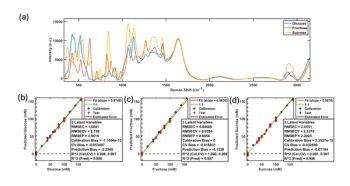
Monitoring Sugar Consumption and Ethanol Production During Yeast Fermentation Using a Raman Plate Reader and Multivariate Analysis
This column shows that a Raman plate reader paired with partial least squares regression can simultaneously quantify glucose, fructose, sucrose, and ethanol in yeast fermentation samples, using turbidity-matched calibration standards to correct for yeast-induced turbidity, and offers a rapid, label-free, high-throughput method for tracking sugar consumption and ethanol production in strain screening, media optimization, and process development.
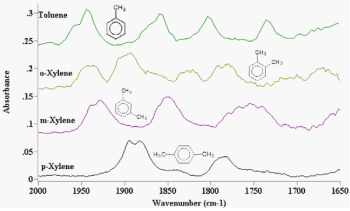
Highly Substituted Benzene Rings—The Rest of the Story II: Spectra
This column, the second installment on highly substituted benzene rings, shows that tri- and tetra-substituted substitution patterns can be distinguished by whether the ring bending peak is present and by the position of the in-phase aryl C-H wagging peak, which shifts according to how many adjacent hydrogens the ring carries.
Healthcare administrator reviewing an insurance policy schedule with a stethoscope on a clipboard, health insurance coverage, medical underwriting, prior authorization, and patient claims processing. | Image Credit: Joi_studio - stock.adobe.com
In a SciX interview, Marc Porter covered a lot of ground, from a student-driven pivot into immunoassays to a baseball analogy for Stokes and anti-Stokes scattering, and shares the open questions he is still chasing.
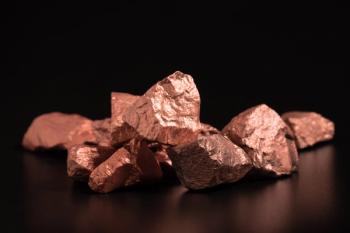
Ingots of pure copper or pink gold on a black background. | Image Credit: Phawat - stock.adobe.com
At SciX, Kevin Wilkinson of the Universite de Montreal explains how faster data acquisition and new software have cut analysis time and how a particle’s chemical composition can link arsenic-bearing emissions back to a copper refinery’s processes.
Spectral Frontiers: Seeing the Unseeable Microspectroscopy
Microspectroscopy, the marriage of spectroscopic chemical identification with microscopic spatial resolution, has advanced from Perkin-Elmer's first commercial infrared microspectrometer in 1953 to today's nanoscale AFM-IR probes, synchrotron-brightness infrared beamlines, and compact hyperspectral tissue imaging devices being developed for AI-assisted cancer detection.