SPEC PerkinElmer 11.10
|Articles|February 1, 2009

Application Notebook

  • Application Notebook-02-01-2009
  • Volume 0
  • Issue 0

Ruggedized NIR Spectrometers: Pharmaceuticals/Neutraceuticals/Food/Ag/PAT

Confirming the water content of pharmaceuticals and food during processing is critical for GmP results. The ability to measure water content until recently has been a difficult challenge until now. As a result of developments in the telecom industry, NIR spectrometers offer highly repeatable, cost effective solutions.

Assuring Water Content During Blending and Mixing Results with NIR Spectrometer

Confirming the water content of pharmaceuticals and food during processing is critical for GmP results. The ability to measure water content until recently has been a difficult challenge until now. As a result of developments in the telecom industry, NIR spectrometers offer highly repeatable, cost effective solutions.

Figure 1

It has been well documented that NIR spectroscopy is an excellent method to measure water in powder mixtures. However, absorption curves are different for each given process and are developed for a given manufacturer's process. Once completed, the understanding and control of the blending process has significant benefits and typically pays for the metrology in time savings, waste reduction, faster time to market, reduced maintenance on machinery, and faster process certification.

Better process control and process understanding has intangible benefits as well. With subtle problems sometimes knowing where not to look can have great value.

Figure 2

Blend Uniformity Measurement

The same instrument that can measure your water during process has the ability to assure blend uniformity. In 2004 the FDA published a guidance document for PAT. The real intent of the document is to get manufacturers to fully understand their product completely during the production cycle. This has many benefits, not the least of which is if the FDA has confidence that the manufacturer understands his processes thoroughly, they are more willing to allow changes to the production process. The manufacturer knowing his product better knows where economies can be improved without adversely affecting product.


Benefits of real time in-situ NIR Spectroscopy are:

  • Greater control of the process

  • Reduced waste

  • Improved yield

  • Shorter time to market

  • Optimized process times

  • Better process understanding

  • Real-time feedback

  • Reduced maintenance

  • Minimal operator involvement

  • Optimizes equipment utilization

  • Improved process documentation

  • Reduced manufacturing costs

  • Better lot-to-lot uniformity

BaySpec, Inc.

101 Hammond Avenue • Fremont, CA 94539 USA

Tel. (510) 661-2008, Fax (510) 661-2009

info@bayspec.com, www.bayspec.com


Related to this article

Highly Substituted Benzene Rings—The Rest of the Story II: Spectra
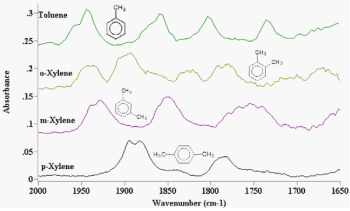
This column, the second installment on highly substituted benzene rings, shows that tri- and tetra-substituted substitution patterns can be distinguished by whether the ring bending peak is present and by the position of the in-phase aryl C-H wagging peak, which shifts according to how many adjacent hydrogens the ring carries.
Healthcare administrator reviewing an insurance policy schedule with a stethoscope on a clipboard, health insurance coverage, medical underwriting, prior authorization, and patient claims processing. | Image Credit: Joi_studio - stock.adobe.com
In a SciX interview, Marc Porter covered a lot of ground, from a student-driven pivot into immunoassays to a baseball analogy for Stokes and anti-Stokes scattering, and shares the open questions he is still chasing.
Ingots of pure copper or pink gold on a black background. | Image Credit: Phawat - stock.adobe.com
At SciX, Kevin Wilkinson of the Universite de Montreal explains how faster data acquisition and new software have cut analysis time and how a particle’s chemical composition can link arsenic-bearing emissions back to a copper refinery’s processes.
Spectral Frontiers: Seeing the Unseeable Microspectroscopy
Microspectroscopy, the marriage of spectroscopic chemical identification with microscopic spatial resolution, has advanced from Perkin-Elmer's first commercial infrared microspectrometer in 1953 to today's nanoscale AFM-IR probes, synchrotron-brightness infrared beamlines, and compact hyperspectral tissue imaging devices being developed for AI-assisted cancer detection.