Application Notes: General

i1-581368-1408661121016.jpg

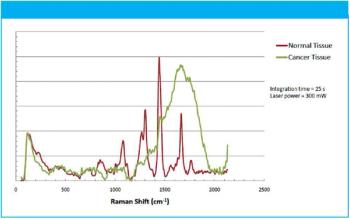
Cardiovascular diseases are among the most important causes of death in The Netherlands. It is of great importance to be able to detect these diseases at an early stage. However, current methods that use classical risk factors such as cholesterol and blood pressure do not come up to the mark.

i4-581418-1408660923353.jpg

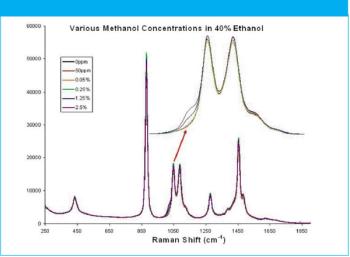
Global warming is seen as a growing problem across the world. One of the major contributing factors to global warming is greenhouse gas emissions and particulates emitted from automobiles. In an attempt to control the particulate emissions from motor vehicles, limits have been placed on the amount of elements such as Sulfur allowed in automotive fuels. Currently in the US, the EPA tier 2 regulations have set the limit for S in road fuels (Gasoline, Diesel and Biodiesel) at 150 ppm.

i4-581421-1408660912233.jpg

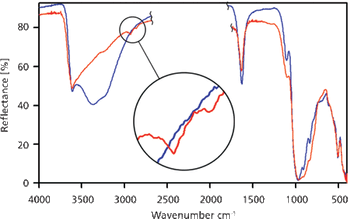
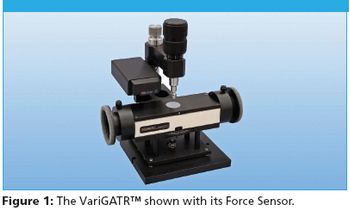
Infrared spectroscopy has long been recognized as a selective and sensitive technique for analysis and characterization of surfaces. From material identification to quantitative analysis, infrared analyses can establish if a surface is composed of the correct material, has the proper coating thickness, is free of contaminants, is properly cured, or has the correct properties for the next step in a manufacturing process.

i1-581369-1408661117285.jpg

It is shown that the Retsch CryoMill polymers are ground to a significantly smaller fineness compared to other methods. Especially for inhomogeneous materials, small particles are the key for a high reproducibility.

i4-581417-1408660926475.jpg

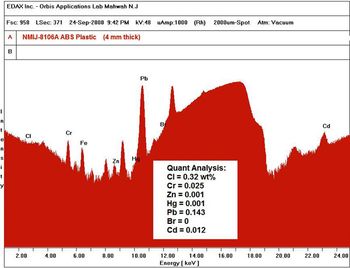
Building on more than 10 years of Micro-XRF experience, the Orbis spectrometer yields a system with excellent Micro-XRF capability while setting a new standard in analytical flexibility. The Orbis incorporates a unique motorized turret integrating video and X-ray optics allowing coaxial sample view and X-ray analysis. The turret can accommodate two additional collimators along with the X-ray optic for a total of three X-ray beam sizes to expand the Orbis analytical capabilities beyond traditional Micro-XRF analysis. Primary beam filters can be used with all spot sizes available on the turret to allow true XRF analytical capabilities in a micro-spot analysis. The working distance is increased to allow analysis over rougher sample topography without sacrificing signal intensity.

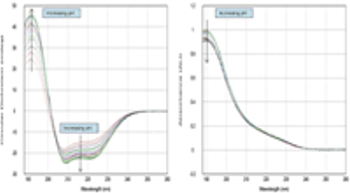
The form and frequency of the amide I band, assigned to the C=O stretching vibration within peptide bonds, is informative and predictive of peptide or protein secondary structure. Fourier-transform infrared (FT-IR) spectroscopy analysis of protein secondary (2°) structure is particularly useful in peptide, protein, or enzyme formulation, widespread in the pharmaceutical and biofuel production industries.

From the Publishers

This September issue of The Application Notebook should be reaching our audience just as the busiest time of the year ramps up in the world of spectroscopy.

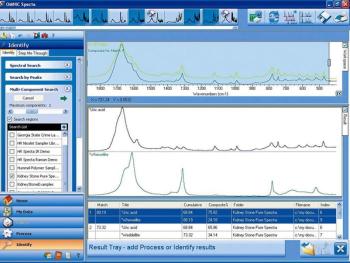
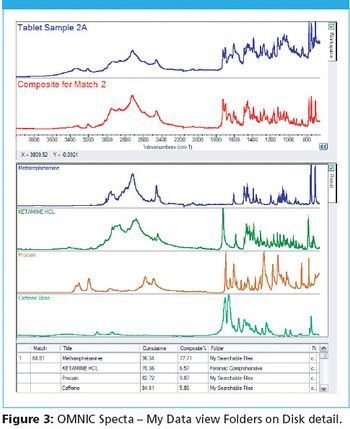
Carbon black rubbers often contain multiple components, but are strongly absorbing in the infrared. The combination of Ge ATR, Advanced ATR correction and multi-component searching permits the full analysis of these important materials.

With gas and diesel fuel prices rising, there is an increasing need to monitor online quality control and blending mixtures. The benefits include improved accuracy in blending mixtures, solid state reliability, lifetime calibration and fraud avoidance.

i4-580063-1408662536744.jpg

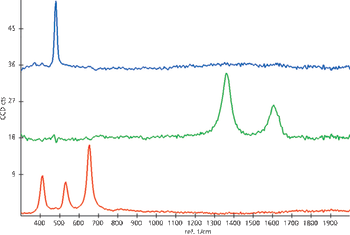
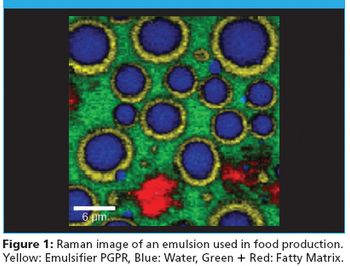
In the Life Sciences, Materials Research, and Nanotechnology, obtaining as much information as possible about the chemical and structural composition of a sample is essential. Confocal Raman Microscopy can play an important role in the nondestructive characterization and imaging of chemical properties while requiring only minimal, if any sample preparation. Systematic and routine research tasks with repetitive experiments or a large number of measurement points, as well as high-level quality control can benefit from an automated instrument.

Spectral measurements down to 153 nm can be achieved easily and economically with the high-sensitivity Maya2000 Pro with Extra-Deep-UV Option. Nitrogen purging of the spectrometer helps to mitigate water and oxygen absorption in the vacuum ultraviolet.

Semiconductor quantum dots (QDs) can be used as nonclassical light sources with applications in next-generation quantum communication and computing. Electrically pumped QDs are all solid-state sources of single photons that are not limited by Poisson statistics (1). Recent work by the group of Dieter Bimberg at Technische Universität-Berlin has demonstrated the selective pumping of a single InAs QD with emission from a single exciton (1–3).

The availability of new silicon drift detectors (SDD) allows for more precise measurements in less acquisition time. SDDs are often praised for their excellent energy resolution, but it is their increased throughput that make them ideal for many industrial applications. Due to the detector's smaller capacitance, a much shorter peaking time is used in the shaping amplifier without sacrificing resolution. This dramatically increases the throughput of the system. Compared with a conventional Si-PIN detector where the peaking time is as long as 25 ms, the drift detector operates at 1.6 ms, thereby increasing throughput from 10,000 counts per second to over 100,000. This advantage can be used in two primary ways.