Application Notes: General

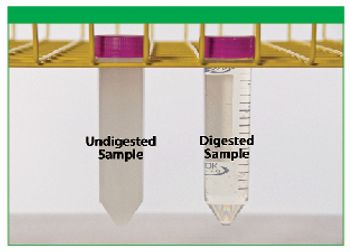
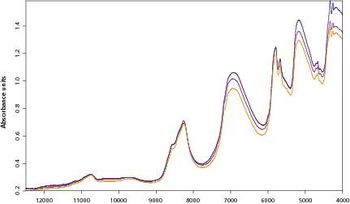
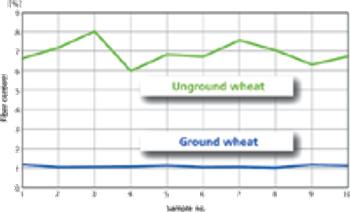
Fat and other nutritional values can easily be determined by NIR analysis. However a proper sample preparation beforehand is essential for a correct result.

i8_t-645506-1408636679214.jpg

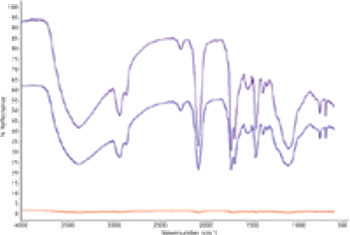
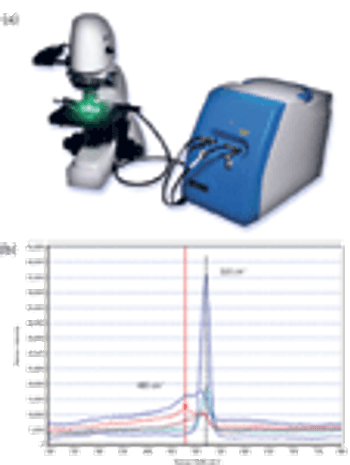
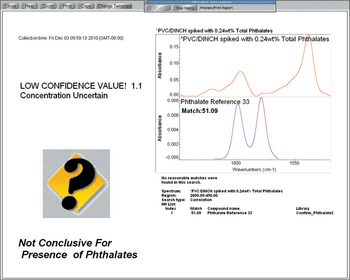
As has been previously discussed (1), FTIR spectroscopy is emerging as a technique that can be effectively used for applications and/or in locations that heretofore would be considered too demanding. The development of portable FTIRs, and more recently handheld FTIRs, is significant because it enables this powerful analytical technique to solve problems for a whole range of new applications, both in the laboratory, and out of the laboratory.

i4-645519-1408636644294.jpg

The development of advanced polymeric materials requires detailed information about the phase separation process on the nanometer scale. Confocal Raman microscopy contributes to the analysis of such materials by visualizing the distribution of individual components based on the unique Raman spectra for different polymeric materials. Using a confocal setup, polymer domains can be imaged three-dimensionally with a resolution down to 200 nm. As a Raman image typically consists of tens of thousands of spectra, a powerful data analysis software is essential in order to extract the relevant information. Hidden structures in the images should ideally be visualized automatically, ensuring an objective and consistent interpretation of the imaging data.

A drug-eluting stent (DES) is an expandable metal alloy framework placed into narrowed coronary arteries that slowly releases a drug coating to treat atherosclerosis. Production of DES is a labor-intensive batch process that requires very tight control. Fourier Transform Near-InfraRed spectroscopy (FT-NIR) is an efficient technique to perform accurate quantification of the different components in DES coating solutions.

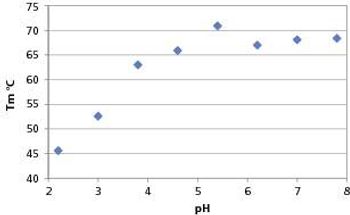
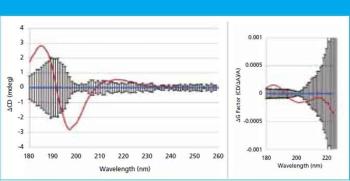
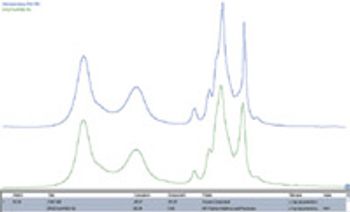
A prerequisite for a successful biotherapeutic formulation is one where the protein is stable and correctly folded. The new technique of dynamic multi-mode spectroscopy (DMS) was used to study the stability of a monoclonal antibody biotherapeutic formulated in acetate and lactate buffers. The samples were measured several times over a period of weeks and it became apparent that the antibody behaved differently as it aged in the two formulations, with the lactate formulation imparting greater robustness than the acetate.

Raman Chemical Imaging technology is able to identify and differentiate multiple components in complex formulated nasal spray suspensions based on chemical makeup. Particle size distribution statistics for the ingredient of interest are produced in a rapid, objective and semi-automated manner. Both solitary and aggregated drug particle sizing information may be obtained.

The analysis of toy samples for toxic trace elements has been undertaken for many years. However, a number of recent cases of toys contaminated with heavy metals has attracted global media attention. This has resulted in an increase in the number of toy manufacturers performing their own 'in-house' testing. This 'in-house' testing is not only to ensure regulatory compliance; it is also proving significantly more cost effective than outsourcing the analysis.

i4-647677-1408635474762.jpg

In ATR/FT-IR, magnified visual monitoring of a sample benefits many applications. For micro-sampling and defect analysis, viewing capabilities decrease overall measurement time by allowing the user to locate the desired sampling area quickly and enhance confidence in the collected data by assuring the sampling point. Visual changes in the sample also may be easily monitored during testing. As an example application, the ease of micro-sampling is shown through fiber analysis and the results are discussed.

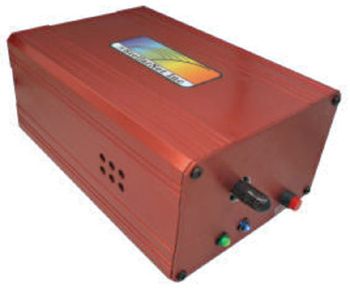
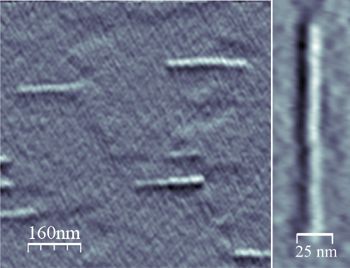
A new Raman spectrometer system, innoRamâ„¢, has been developed to provide research-grade performance in either a lab or a mobile environment. The Raman analysis of carbon nanotubes using innoRam in comparison with a Raman spectrometer using a conventional front illuminated CCD demonstrates distinctive improvements for innoRam in both sensitivity and signal-to-noise ratio (SNR).

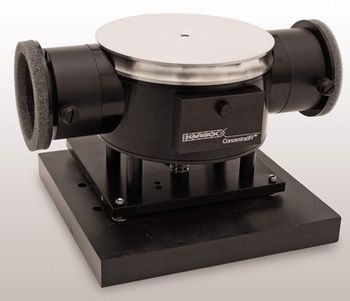
Ultraviolet (UV) spectrophotometry has a well-deserved niche. Many UV-Vis instruments claim to work to the deep UV. Few instruments optimize for, or cater to, the 120 to 400 nm region. Development and manufacture of ultraviolet lasers, optics, crystalline materials, and resonance Raman instruments, as well as basic research, require a broadly useful instrument for analysis, characterization, and test. Enter McPherson's Vacuum Ultraviolet Analytical Spectrophotometer (VUVAS.)

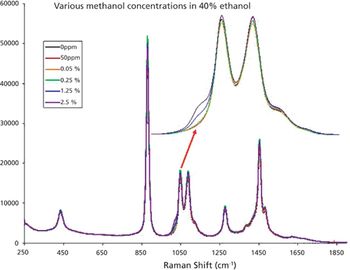
High sensitivity Raman analyzers could provide solutions for continuous and automated measurements of low concentration ions or molecules in aqueous solutions for applications in industries including biomedical, mining, agrichemical, pharmaceutical, cleaning, and environmental. As an example for similar applications, the quantitative analysis of low concentration sulfate ion in aqueous solution down to as low as 2.5 ppm by conventional (Non-SERS) Raman is demonstrated.

Detection of contaminants in consumer products is a critical public-safety need. One of the challenges of this type of detection is that the contaminant chosen is frequently designed to "fool" the routine product-safety testing performed. For example, melamine as the adulterant of choice to lower the cost of milk is because melamine contains nitrogen molecules.

Confirming the water content of pharmaceuticals and food during processing is critical for GmP results. The ability to measure water content until recently has been a difficult challenge until now. As a result of developments in the telecom industry, NIR spectrometers offer highly repeatable, cost effective solutions.

The new technique of dynamic multi-mode spectroscopy (DMS) was used to study the stability of a monoclonal antibody biotherapeutic formulated in acetate and lactate buffers. The samples were measured several times over a period of weeks and it became apparent that the antibody behaved differently as it aged in the two formulations, with the lactate formulation imparting greater robustness than the acetate.

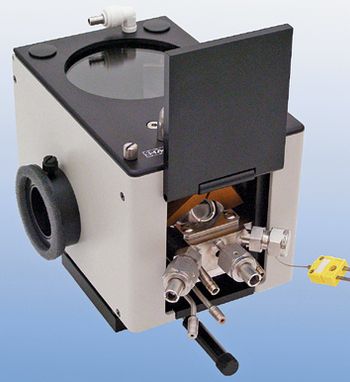
Some powders and rough surfaced solids change color as a function of temperature, a phenomenon known as thermochromism. Such phenomena can be effectively studied by UV-Visible spectroscopy in combination with a diffuse reflection accessory equipped with temperature-controlled reaction chamber, as demonstrated here with a thermal paint.

i3_t-581416-1408660929120.jpg

Energy generation using photovoltaic devices is regarded as an important component in overcoming future energy shortages. This is reflected in a dramatic increase in photovoltaic production and demand. In the research and development of photovoltaic devices, the primary goals are to increase the conversion efficiency of the solar cells or to improve the production process. The following study describes the application of Confocal Raman Imaging for the analysis of stress fields around laser-drilled holes on a Si solar cell using the large area scanning capabilities of the WITec alpha500 Confocal Raman Microscope.

i1-581368-1408661121016.jpg

Cardiovascular diseases are among the most important causes of death in The Netherlands. It is of great importance to be able to detect these diseases at an early stage. However, current methods that use classical risk factors such as cholesterol and blood pressure do not come up to the mark.

i4-581418-1408660923353.jpg

Global warming is seen as a growing problem across the world. One of the major contributing factors to global warming is greenhouse gas emissions and particulates emitted from automobiles. In an attempt to control the particulate emissions from motor vehicles, limits have been placed on the amount of elements such as Sulfur allowed in automotive fuels. Currently in the US, the EPA tier 2 regulations have set the limit for S in road fuels (Gasoline, Diesel and Biodiesel) at 150 ppm.

i4-581421-1408660912233.jpg

Infrared spectroscopy has long been recognized as a selective and sensitive technique for analysis and characterization of surfaces. From material identification to quantitative analysis, infrared analyses can establish if a surface is composed of the correct material, has the proper coating thickness, is free of contaminants, is properly cured, or has the correct properties for the next step in a manufacturing process.

i1-581369-1408661117285.jpg

It is shown that the Retsch CryoMill polymers are ground to a significantly smaller fineness compared to other methods. Especially for inhomogeneous materials, small particles are the key for a high reproducibility.

i4-581417-1408660926475.jpg

Building on more than 10 years of Micro-XRF experience, the Orbis spectrometer yields a system with excellent Micro-XRF capability while setting a new standard in analytical flexibility. The Orbis incorporates a unique motorized turret integrating video and X-ray optics allowing coaxial sample view and X-ray analysis. The turret can accommodate two additional collimators along with the X-ray optic for a total of three X-ray beam sizes to expand the Orbis analytical capabilities beyond traditional Micro-XRF analysis. Primary beam filters can be used with all spot sizes available on the turret to allow true XRF analytical capabilities in a micro-spot analysis. The working distance is increased to allow analysis over rougher sample topography without sacrificing signal intensity.