SPEC PerkinElmer 10.13

Related to this article

Infrared Reimagined: How FT-IR Spectroscopy Learned to Read Molecules, ©  Luis Eduardo  -chronicles-stock.adobe.com
FT-IR spectroscopy, long treated as a mature bench technique for confirming a carbonyl stretch or fingerprinting a polymer, has quietly become one of chemistry’s most versatile discovery engines: it now infers molecular structure straight from a spectrum without a reference library, resolves chemistry tens of nanometers wide, and screens a fingerstick of blood for disease in minutes. The last five years of published research show FT-IR moving from a confirmatory tool into a predictive, autonomous, and field-ready analytical platform.
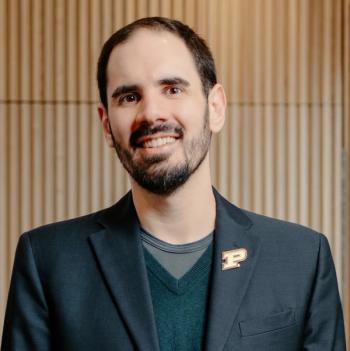
Brandon E. Boor is the Dr. Margery E. Hoffman Associate Professor in the Lyles School of Civil and Construction Engineering at Purdue University. | Photo Credit: © Brandon Boor.
In the second part of our interview with Brandon Boor of Purdue University, he discusses how his team controls experimental variables during cleaning experiments in order to obtain interpretable data.
Sizing Up the Nanoscale: Measuring Nanocluster Aerosol in Indoor Air
In the first part of a multi-part Q&A, Brandon Boor, the Dr. Margery E. Hoffman Associate Professor in the Lyles School of Civil and Construction Engineering at Purdue University, describes the instrumentation and methodology behind measuring nanoparticle size distributions at the nanocluster scale (1–3 nm) and outlines the technical challenges of acquiring reliable, real-time data at these dimensions.
NIR Spectroscopy of the Brain and Other Complex Analyses, ©   Navaporn  -chronicles-stock.adobe.com
Near-infrared spectroscopy has quietly stopped being a niche calibration exercise and started acting like an autonomous diagnostic partner, reading consciousness in an injured brain, steering a fermenter without a human hand, and hunting invisible plastic in a glass of water. The tool chemists once used to check moisture in grain is now fusing with artificial intelligence to make decisions no spectrometer could make alone.