How do ions and water interact at the atomic level in nanochannels grafted with polymer brushes using all-atom molecular dynamics simulations? Siddhartha Das of the University of Maryland and his team are working on answering this question.
A recent conversation with Kevin Wilkinson, a professor of environmental chemistry at the Université de Montréal, sheds light on why no single signature can separate engineered nanoparticles from natural ones.
At the SciX 2026 Conference, which took place in Sparks, Nevada, we sat down with Kevin Wilkinson, a professor of environmental chemistry at the Université de Montréal, to talk about him receiving the Lester W. Strock Award and
Wilkinson’s group combines many techniques, with elemental and isotope ratios proving especially useful in complex, heterogeneous systems. And as he stated in our conversation, this strategy is necessary for distinguishing engineered nanoparticles from naturally occurring ones.
I am extremely honored to have won this award. It was completely unexpected. This is an award where we don't ask to be nominated or we do nothing to try and win it, so it was a very pleasant surprise. I consider it somewhat unearned, because my view is that I'm inspired by the work of others, by reading other papers, and I look for things I can do in other people's research. And then I take it and I assign it to some of my students, so they're doing the work and I'm just the intermediate. So, I don't know if it's really me that should be getting the award or the people on each side of me.
I wish there was a key signature or just one technique to be able to do this. Unfortunately, that's not the case yet. We're looking to combine a multitude of techniques and different signatures, so implying big data and suggesting that we're going to need many techniques and many ways of analyzing the results from the techniques that we're using. Putting all that together, I can't say there is a key signature, but as we go along with this, we see things that are more useful than others in the elemental and isotope ratios. These are helping us understand the systems and identify markers of these rare events, and that's been very helpful for us to progress with our knowledge of these very complex environmental systems that are entirely heterogeneous, polydisperse, and difficult to characterize.
In regard to
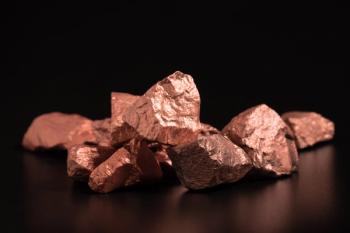
The fact that the particles had no copper was expected. We're outside a copper extraction facility. They're trying to take out the copper, and so it was perfectly normal to see particles with little copper left. The thing that's really interesting here is some of the combinations. They used a combination of recycling and ores as their inputs for these processes. When we see particles coming out of the refinery with elements from the recycling and from the ores, that can tell us it's coming either from the stack or from fugitive emissions, but it's really coming from the process.
That's giving us insight, and these particles tend to be smaller. They are the particles where the arsenic is often located, and these are the particles that tend to be transported away from the facility, so it's helpful for us to understand those particles through their chemical composition.
The
So perhaps we should learn from them and go a little further out or look at the composition of particles in the snow at these further distances. We know from their work that the particles are being transported very long distances and going a long way away from the source where they are being produced.
I like to tell my students to learn how to learn. That's the only thing that I expect in a PhD student. If they can learn how to learn, they'll be able to adapt to different conditions. That being said, and in addition, the instrumentation is evolving so quickly right now that it's a little bit difficult to focus on one type of instrumentation. In three years, the instrumentation will evolve, and we'll have something much better.
In terms of instrumentation, I would avoid making any recommendations to my students. Instead, I would tell them to learn how to evaluate whether these instruments are going to do what they say they're going to do because salespeople will always tell us, "This is the best thing since sliced bread," and we have to be able to evaluate that.
The final point is that students need to learn how to analyze the data using big data techniques. Everything we're doing as analytical chemists now has evolved towards big data analysis, so whereas 20 years ago we'd make a few measurements and try and put that together in a report, now we're getting gigabytes or terabytes of data per sample or samples. Therefore, we've got to be able to analyze that efficiently. They should be able to pull the important results out of the data using these advanced data treatment and statistical techniques.