Croatian researchers outline how optical emission spectroscopy (OES) can track reactive species and plasma parameters in real time, giving processors a path to move cold plasma treatments from the laboratory to production lines.
Top articles include interviews from our coverage of the Eastern Analytical Symposium (EAS) and a compilation of our evergreen content from 2026.
As part of our coverage of the Eastern Analytical Symposium (EAS), we sat down with Garth Simpson of Purdue University and Kristin Wustholz of William & Mary to talk about their group’s recent research endeavors. We’ll provide insights from those conversations here. Also, we explore the term “electroslippage,” and highlight 143 pieces of evergreen content published on our website this year.
This is the Best of the Week.
First, Garth Simpson of Purdue University described how his group is extending fluorescence recovery after photobleaching (FRAP) to map molecular mobility across space and time in pharmaceutical formulations and materials. Whereas conventional FRAP measures diffusion at a single point, Simpson’s team photobleaches a patterned dot array, applies a spatial Fourier transform, isolates one frequency peak, and converts it back into a real-space image.1 Tracking the decay of that amplitude produces a diffusion coefficient at every pixel, roughly a quarter million per experiment, in an approach Simpson compares to lock-in detection.1
Also at EAS, Kristin Wustholz of William & Mary explained why her group developed fluorescence blinking as a complement to surface-enhanced Raman spectroscopy (SERS) for identifying dyes in cultural heritage objects. Because transferring analytes onto plasmonic substrates is challenging, the team treats blinking as a molecular barcode.2 Since blinking statistics overlap broadly between dyes, the group applies multinomial logistic regression (MLR) to evaluate them across multiple dimensions, distinguishing rhodamine B from rhodamine 6G.2 After testing approximately 10 machine learning methods, they selected MLR for its interpretable coefficients and probabilities.2
Spectroscopy’s year-in-review distills the most novel advances from
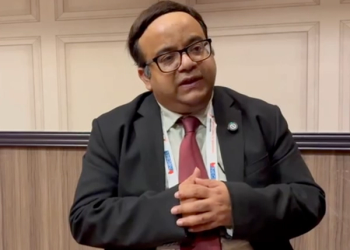
At SciX 2026, Siddhartha Das of the University of Maryland, recipient of the AES Mid-Career Award, discussed electroosmosis in polymer brush-grafted nanochannels. Through simulations, his group shows that ion placement relative to the brush governs how ions drag water, sometimes reversing flow.4 Das explained “
And that’ll do it for Best of the Week. Thanks for reading, and we’ll see you next week.