In an interview at SciX, Alessandro De Giacomo discusses nanoparticles as signal enhancers and medical tags, a self-calibrating drone LIBS system, open questions in laser–matter interaction, and why students need a strong foundation in fundamentals.
Laser-induced breakdown spectroscopy (LIBS) is being used in numerous application areas, including environmental monitoring, cultural heritage, and space exploration.
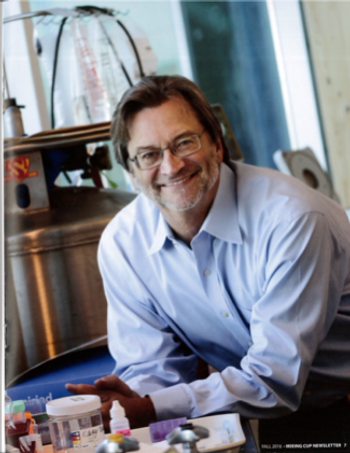
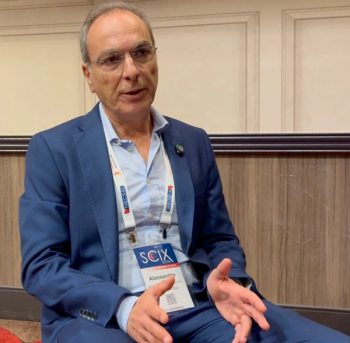
In a SciX 2026 interview with Spectroscopy, Alessandro De Giacomo, a University of Bari Aldo Moro professor being honored with a dedicated Spectrochimica Acta Part B award session, discussed his work on laser-induced breakdown spectroscopy (LIBS), the physics of laser-induced plasmas, and nanoparticle-enhanced LIBS for applications ranging from environmental monitoring to cultural heritage and space exploration.1–5 Below is a text transcript of our conversation with De Giacomo.
In that case, we directly used nanoparticles for coupling the plasmonic effect with the laser and increasing the signal by two orders of magnitude. Then, we found out that these nanoparticles can also be used for tagging some important markers for various diseases, which can be Alzheimer's or checking the amount of ferritin in older people.
We understand that these nanoparticles can be an ideal tag because they have a very high efficiency of emission in the plasma. I think beyond the applications that we are discussing with our latest publications, there is still a great general interest in using these nanoparticles as tags for several medical applications.
Nowadays, we have a good knowledge and understanding of the plasma itself. What I think is still not fully understood is the laser–matter interaction and the ejection of material.
How this really occurs, and especially how this system works is different because this is not a homogeneous system but a heterogeneous system, where you have the gas plasma phase, and you also have a condensed phase that interacts during all of the evolution of the plasma.
This is something that is not studied as deeply as the typical plasma characteristics. I think that this is something the community should be more focused on.
Fortunately, smaller nanoparticles have a very high efficiency of vaporization, so they become mostly emitters. But clearly, the bigger nanoparticles have a higher amount of atoms, and they are more useful where the sensitivity of the technique is concerned.
At the same time, we should keep in mind that when we are tagging, for example, exosomes, which are particles that can be 100 nm or even smaller, we also have to keep in mind the steric effect that these nanoparticles could have. Therefore, you have to choose a nanoparticle that allows you to tag your system. Maybe you can do a multiple tag, which means multiplex analysis. In that case, you cannot use such big nanoparticles. It's always a compromise, depending on which kind of tag we are looking for.
The selection is done by the whole editorial board and team. I'm talking about 35 international members of this jury. This year, one paper was selected that was very technical, on the use of intensified
The idea of using LIBS in a drone is not new. However, until now, there has not been an operating system because you have two main problems when you deal with a drone. The first is the positioning, which depends on the satellite connection and consequently has an uncertainty that, in the best case, can be some centimeters.
Then, we have to take into account that during the flight, we have oscillation and tilting, so using the traditional approach, based on the comparison of the measurement with some reference measurement, is not possible because you never know exactly. You are not able to reproduce your standard experiment exactly. With this self-calibration, everything is done in the measurement, so all the information, including the instrumental calibration and the quantification of the elements, comes directly from the measurement of the signal.
This gives a huge freedom in the use of the drone. I think this is why this is the first—from what I know, at least—the first operating system able to do in-flight measurements with quantitative information that is very acceptable, down to 0.1%.
We can detect even ppm, but we are not able to quantify with this method. But for drone applications, your sample is not just a few centimeters; we are talking about kilometers, so it is not that important to have such a small accuracy because the sample is so wide that if you shoot one meter after, you have a different composition, and you're interested in having an overview of the field that you are flying over.
I've been a professor for 27 years, so for me, this is a very important question. The students should be formed on the fundamental aspects of science; sometimes, there is a trend of going directly to the application because now we have high-end technology, but this allows you to exploit a spectroscopic technique for several applications. It does not allow you to have an idea that can be a real revolution, so this is what we should teach our students because we don't need evolutionary work forever. We need revolutionary work. This is a crucial point that the institutions should understand when they manage students.