SPEC PerkinElmer 10.13
News|Videos|October 2, 2026

Best of the Week: SpecAcademy, The Transformation of Raman Spectroscopy

Top content published this week include a panel discussion with five SpecAcademy instructors and a feature article on Fourier transform infrared (FT-IR) spectroscopy.

With the launch of SpecAcademy, spectroscopists and industry professionals now have access to an educational resource that can help maintain method mastery and acquire new knowledge to help them in their careers. A recent panel discussion with five SpecAcademy instructors highlights the state of spectroscopy education and how SpecAcademy is going to help fill the gaps. Also, Raman spectroscopy is going through a change thanks to artificial intelligence (AI). What does this mean for the industry? We’ll discuss it here.

This is the Best of the Week.

SpecAcademy is designed to allow spectroscopists and industry professionals to build technical expertise and develop their skills throughout their careers. A recent panel discussion brought together five SpecAcademy instructors—Ellen Miseo, Peter Larkin, Mary Carrabba, Jeff D’Agostino, and James de Haseth—to discuss the current state of spectroscopy education and the gaps SpecAcademy aims to address.1 The panelists explained how academic training does not always prepare new analysts for the practical challenges of industrial problem solving.1 They also discussed the loss of traditional mentorship opportunities and the need for spectroscopy education across industrial, government, and military laboratories, as well as for scientists who may not have extensive chemistry or vibrational spectroscopy backgrounds.1

And SpecAcademy isn’t the only area of spectroscopy experiencing change.

Infrared (IR) spectroscopy is also receiving a fresh look. SpecAcademy instructors emphasize the importance of selecting an analytical technique based on the sample and the information needed, rather than relying on familiarity or instrument preferences.2

Meanwhile, Raman spectroscopy is being reshaped by artificial intelligence, coherent detection, and instrument miniaturization. Deep-learning models such as Vib2Mol can analyze spectra and generate candidate molecular structures, while stimulated Raman scattering microscopy is enabling high-speed chemical imaging at the single-particle level.3

At the same time, advances in detection technology and miniaturization are helping bring Raman spectroscopy into portable and handheld formats, expanding its use for applications ranging from pesticide screening to hazmat identification.3

And finally, advances in Fourier transform infrared (FT-IR) are expanding what the technique can accomplish. Deep learning, nano-FTIR, atomic force microscopy–infrared (AFM-IR), microfluidic ATR-FT-IR imaging, portable instrumentation, and hyperspectral data fusion are pushing IR spectroscopy toward applications in molecular identification, biomanufacturing, disease screening, and microplastic analysis.4

From education to AI and advanced instrumentation, spectroscopy continues to evolve and so do the tools available to those working in the field.


References
  1. Miseo, E.; Carrabba, M.; Larkin, P. J.; D’Agostino, J.; de Haseth, J.; Wetzel, W. What is SpecAcademy and What Need Does It Fill? Spectroscopy Online, 2026. https://www.spectroscopyonline.com/view/what-is-specacademy-and-what-need-does-it-fill- (accessed September 25, 2026).
  2. Miseo, E.; Carrabba, M.; Larkin, P. J.; D’Agostino, J.; de Haseth, J.; Wetzel, W. The Right Tool for the Job: Why Infrared Spectroscopy Deserves a Second Look. Spectroscopy Online, 2026. https://www.spectroscopyonline.com/view/the-right-tool-for-the-job-why-infrared-spectroscopy-deserves-a-second-look (accessed September 25, 2026).
  3. Workman, Jr., J. Beyond the Fingerprint: AI, Coherent Detection, and Miniaturization Are Redefining Raman Spectroscopy. Spectroscopy Online, 2026. https://www.spectroscopyonline.com/view/beyond-the-fingerprint-ai-coherent-detection-and-miniaturization-are-redefining-raman-spectroscopy (accessed September 29, 2026).
  4. Workman, Jr., J. Infrared Reimagined: How FT-IR Spectroscopy Learned to Read Molecules, Diagnose Disease, and See Below the Diffraction Limit. Spectroscopy Online, 2026. https://www.spectroscopyonline.com/view/infrared-reimagined-how-ftir-spectroscopy-learned-to-read-molecules-diagnose-disease-and-see-below-the-diffraction-limit (accessed September 25, 2026).

Related to this article

Infrared Reimagined: How FT-IR Spectroscopy Learned to Read Molecules, ©  Luis Eduardo  -chronicles-stock.adobe.com
FT-IR spectroscopy, long treated as a mature bench technique for confirming a carbonyl stretch or fingerprinting a polymer, has quietly become one of chemistry’s most versatile discovery engines: it now infers molecular structure straight from a spectrum without a reference library, resolves chemistry tens of nanometers wide, and screens a fingerstick of blood for disease in minutes. The last five years of published research show FT-IR moving from a confirmatory tool into a predictive, autonomous, and field-ready analytical platform.
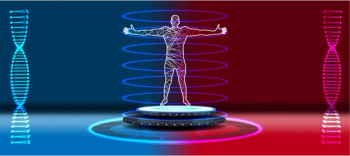
Human body wireframe on glowing platform undergoing futuristic body scan. © sergray(noAIelemens) -chronicles-stock.adobe.com
Jurgen Popp, Thomas Mayerhofer, and colleagues at Leibniz IPHT and Friedrich Schiller University Jena introduce the Personalized Optical Digital Twin (PODT), a Photonics21 contribution to Europe's Virtual Human Twin ecosystem that connects molecular photonics—Raman blood analysis, coherent Raman tissue imaging, and multimodal endomicroscopy—with longitudinal physiology and clinical data. Drawing on the published multicenter INTELLIGENCE trials, the authors argue that technical feasibility and clinical utility must be evaluated separately as the field moves toward Europe's FP10 research agenda.