
Sponsored Content
Spectral Systems has developed its Diamond XP-BBAR™ coating with spectral performance. The SNR is about 30% better through most of the analysis region of a typical FT-IR instrument.
Sponsored Content
Spectral Systems has developed its Diamond XP-BBAR™ coating with spectral performance. The SNR is about 30% better through most of the analysis region of a typical FT-IR instrument.
Special Issues
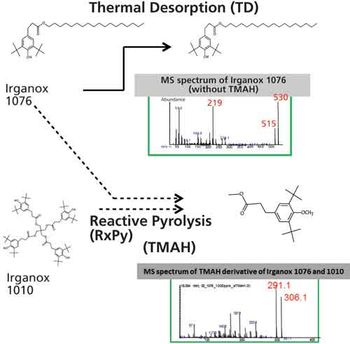
This application note details a GC-MS-based analytical method for the qualitative and quantitative determination of Irganox 1076 and 1010 in polyethylene.
Special Issues
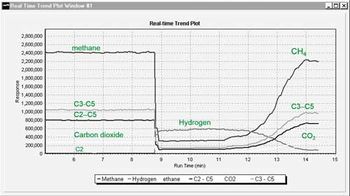
The Diablo 5000A RTGA-MS allows the process stream to be seen in real-time and provides quantitative data with reliable mass information. The result is visualization.
Special Issues
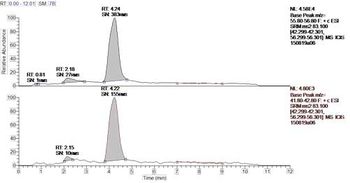
This work will demonstrate a simple methodology using automated solid-phase extraction (SPE) and HPLC coupled with mass spectrometric detection. This work will demonstrate a simple methodology using automated solid-phase extraction (SPE) and HPLC coupled with mass spectrometric detection. This work will demonstrate a simple methodology using automated solid-phase extraction (SPE) and HPLC coupled with mass spectrometric detection.
Special Issues
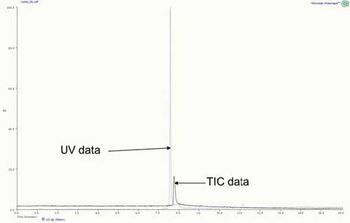
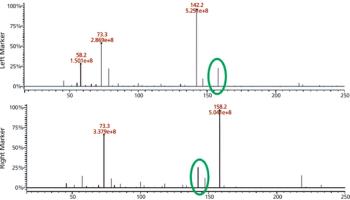
Detecting impurities in any chemical reaction is becoming increasingly important to detect those present at low levels (for example, 0.5%).
Special Issues
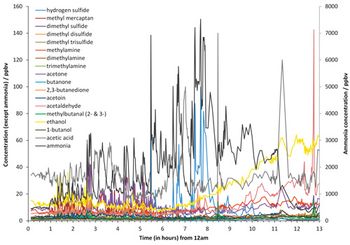
The sensitive, selective, and real-time analysis characteristic of the SIFT-MS technique provides simple, robust, and continuous analysis of extremely diverse odor compounds at trace levels in air. This application note illustrates instantaneous, broad spectrum odor analysis with monitoring data from a chicken meat production facility.

Special Issues
A rapid, accurate, and reproducible method was developed for high-throughput testing of nicotine, cotinine, trans-3’-hydroxycotinine, nornicotine, norcotinine, and anabasine in urine. Data show that a fast and highly efficient analysis of these basic compounds can be achieved with the Raptor Biphenyl column using standard reversed-phase LC–MS mobile phases that are compatible with a variety of LC–MS instrumentation.
Special Issues
Bruker Daltonics, Inc.
Application Notebook
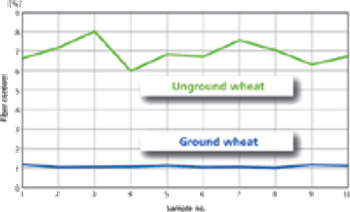
A much discussed issue related to near infrared analysis (NIR) is the necessity of sample preparation. Ground and unground samples of wheat were analyzed to determine how truly necessary it is to homogenize samples before NIR analysis. The new Retsch TWISTER mill, specifically designed for NIR sample preparation, was utilized for this comparative study.
Application Notebook
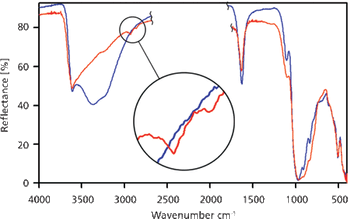
Increasing temperature can cause chemical changes, alter reaction rates, concentrate an aqueous sample, or evaporate a solvent. These transformations can be readily monitored by diamond ATR spectroscopy. This note explores the use of a diamond ATR to examine heat-induced changes in the clay.
Application Notebook
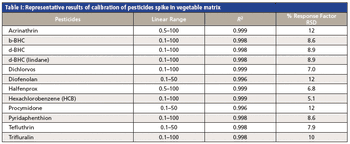
There are nearly one thousand pesticides used in modern agricultural practice, and the residues of pesticides in the food from plant origins have been an increasing concern for consumers worldwide. Monitoring programs based analytical methodologies are established to ensure that the pesticide levels in plant foods are in compliance with national and international laws. However, the diversity of pesticides and complexity of food sample matrix present ongoing challenges for analytical chemists to meet the increasingly stringent requirements for sensitivity, precision, and throughput.
Application Notebook
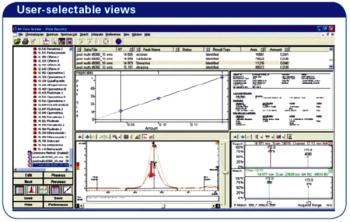
There are currently more than 1000 pesticides in use worldwide in the production of foodstuffs. There is a significant risk to human health and the environment due to increased pesticide use, poor agricultural practices and illegal use.

Application Notebook
The amaZon series is the next step in Bruker Daltonics' family of ion trap mass spectrometers.
Application Notebook
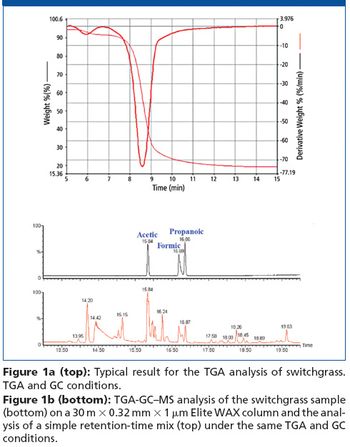
Thermogravimetric analysis (TGA) measures the change in the weight of a sample as a function of temperature.
Application Notebook
Applied Biosystems/MDS SCIEX
Application Notebook
Thermo Fisher Scientific
Application Notebook
Thermo Fisher Scientific
Application Notebook
Hitachi High Technologies America, Inc.

Application Notebook
Advanced Chemistry Development, Inc.(ACD/Labs)

Application Notebook
Hitachi High Technologies America, Inc.

Application Notebook
BURLE Electro-Optics, Inc.

Application Notebook
Gabriela Zurek, Birgit Schneider, and Carsten Baessmann, Bruker Daltonik GmbH

Application Notebook
Michael Leist, ray Leiser, and Andrew Toms, Varian, Inc.