This application note demonstrates using ATR to examine the changes in surface orientation as a function of the distance from the injection point or gate.
This application note demonstrates using ATR to examine the changes in surface orientation as a function of the distance from the injection point or gate.

Diamond ATR has become one of the most commonly used FT-IR spectroscopy methods. However, the strong diamond lattice bands in the 2300–1900 cm-1 region make it difficult to measure the functional groups from nitriles, isocyanates, isothiocyanates, diimides, azides, and ketenes that would normally appear in that region. This applications note compares the sensitivity of a single-reflection ATR to multiple-reflection ATR for the nitrile functional group infrared transition.

This application note demonstrates determining the correct orientation of the polarizer for these measurements and illustrates the importance of polarized measurements in specific examples.
Because of their corrosive properties, corrosive lipids are challenging to analyze by ATR-FT-IR. Repeated and prolonged analysis can damage many ATR crystals. Diamond ATR is a better choice for such applications than other ATR crystal materials like ZnSe and Ge. This application note examines a corrosive liquid as it becomes progressively more concentrated using diamond ATR.

Tribology-the study of friction, wear, and lubrication-is important in mechanical, electromechanical, and biological systems. Changes in materials due to abrasion, friction, lubrication, erosion, and corrosion result in failures of the moving components during use. These effects are usually minimized by careful surface finish design and lubrication. Recycling and refinishing surfaces can extend the lifetimes of components. By examining worn surfaces, better methods can be developed to prevent wear. This applications note uses infrared spectroscopy to study tribology changes in steel.


Sponsored Content
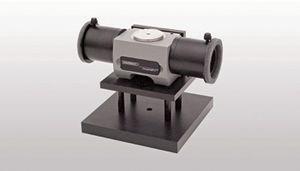
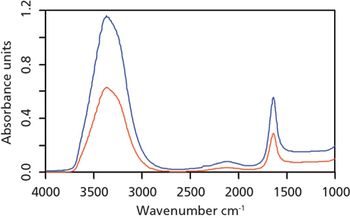
Multiple reflection attenuated total reflection FT-IR accessory allows for protein analysis of strongly IR-absorbing samples, such as aqueous solutions.

Application Notebook
Spectroscopy
This applications note explores the potential of using a highthroughput single-reflection diamond ATR to detect structural changes in egg yolk upon heating.
Spectroscopy
For all measurements, a Harrick Wire Grid Polarizer (KRS-5 substrate) was used. The polarizer was oriented in the same position for both background and sample measurements. All spectra were collected using an FT-IR spectrometer at an 8 cm-1 resolution averaged over 32 scans.
Application Notebook
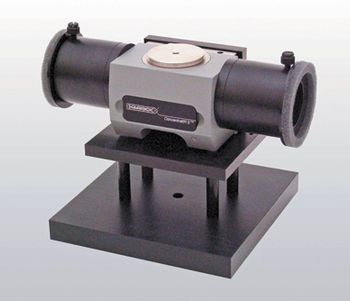
Fermentation processes have been used since the Neolithic era and are widely used today in diverse fields such as foods, beverages, and pharmaceuticals.
Application Notebook
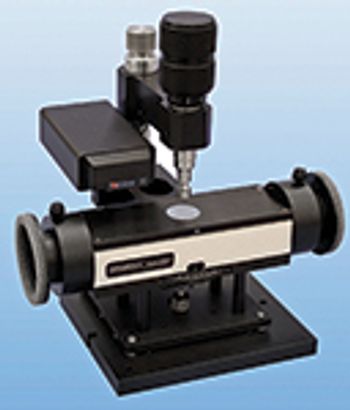
Grazing angle Ge ATR spectroscopy is extremely sensitive to monolayers and thin films on high refractive index substrates such as Si.

Application Notebook
Multiple reflection ATR is ideal for detecting miniscule levels of components in solutions. If one component is volatile, trace analysis can be simplified by allowing the volatile liquids to evaporate.
Application Notebook
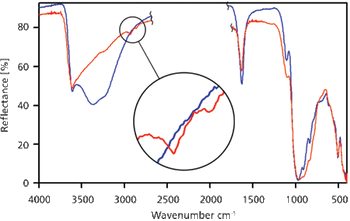
Increasing temperature can cause chemical changes, alter reaction rates, concentrate an aqueous sample, or evaporate a solvent. These transformations can be readily monitored by diamond ATR spectroscopy. This note explores the use of a diamond ATR to examine heat-induced changes in the clay.

February 1st 2020

September 1st 2019

September 1st 2020

February 1st 2021