At SciX, Marc Porter explains how a Thanksgiving batting lesson led him to compare a bat meeting a ball to light scattering off a molecule, and how his group is using simulations to test whether the analogy holds.
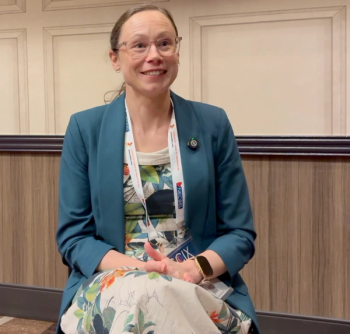
In this interview clip, Naihao Chiang of the University of Houston discusses how to better improve the performance of scanning ion-conductance microscopy–tip-enhanced Raman spectroscopy (SICM-TERS).
Naihao Chiang, an assistant professor of chemistry at the University of Houston, and his group is currently working with TERS in vibrational nanoscopy. At Pittcon 2026 in San Antonio, Texas, we sat down with Chiang to ask him about his work. After getting his thoughts about the conference experience in the
In the below clip of our interview with Chiang, he addresses two questions. First, he discusses the complexities of conducting liquid phase studies using scanning probes, emphasizing the need for acoustic noise isolation and vibration control. Chiang highlights the importance of probe construction for maximizing signal strength, referencing his Ph.D. advisor's work on surface-enhanced Raman spectroscopy (SERS). Second, Chiang suggests starting with SERS to simplify studies and optimize fabrication conditions, such as high vacuum sputtering, before advancing to more complex techniques like tip-enhanced Raman spectroscopy (TERS). They propose a gradual approach to SERS and TERS, using SERS to establish reliable probes before moving on to TERS.
Spectroscopy will be continuing to provide coverage of the Pittcon 2026 conference on an ongoing basis as we report back from San Antonio. You can stay up to date with our coverage of the Pittcon 2026 conference