NIR calibration has always been data-hungry, and biological processes rarely produce enough labeled spectra to satisfy a deep neural network. The most inventive response has been to generate the missing data outright. A transformer-based architecture enhanced with a Wasserstein generative adversarial network created synthetic spectra to monitor hyaluronic acid fermentation, using the augmented dataset to overcome calibration limits imposed by sparse, noisy bioprocess sampling.10 The implication extends well beyond one fermentation: if a model can be trained on spectra that were never physically measured, the sample-scarcity problem that has limited NIR calibration in biopharmaceuticals, rare-disease diagnostics, and novel materials may no longer be a hard ceiling.
Seeing Consciousness, Diagnosing Disease: NIR Enters the Clinic
The clinical applications of NIR published since 2024 are striking for a technique historically associated with grain elevators. Functional NIR spectroscopy has been used to detect resting-state neural networks and task-driven brain activity in behaviorally unresponsive, severely brain-injured patients, revealing preserved awareness that standard bedside examination missed entirely.11 That single finding challenges a diagnostic paradigm built on behavioral observation and raises real questions about how “unresponsive” is defined in intensive care. Elsewhere, NIR spectra of serum, combined with machine learning, have detected the presence of hepatitis C virus (HCV) in serum microsamples by identifying subtle shifts in the water and lipid matrix, and combining those spectral features with routine clinical variables raised diagnostic accuracy above 72%, with an area under the curve (AUC) of 0.850.12,13 In neurology, functional NIR is now distinguishing mild cognitive impairment (MCI) from Alzheimer’s disease (AD) through consistent reductions in tissue oxygenation and functional connectivity, with machine-learning classifiers reportedly reaching accuracies near 90%.14 Liver disease has not been left out either: NIR combined with neural network and support vector machine classification is being used to stage fibrosis noninvasively, a task that traditionally required biopsy.15 Each of these results depends on NIR’s ability to probe hemoglobin, water, and lipid chemistry noninvasively through tissue, but the diagnostic reach is new.
Watching the Planet: NIR’s Environmental Frontier
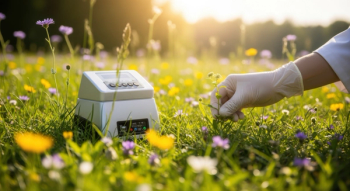
Environmental monitoring has become one of NIR’s fastest-growing application areas, largely because the technique’s speed and minimal sample preparation suit field surveys better than laboratory-bound alternatives.16 NIR spectroscopy paired with machine learning has been used to detect colorless microplastic particles in environmental samples, a genuinely difficult target because such particles lack the strong, distinctive absorption bands that make mid-infrared identification straightforward.17 Soil and vegetation properties are being screened the same way, giving ecologists a rapid, nondestructive tool for large-scale conservation surveys where laboratory analysis of every sample would be impractical.18 None of these environmental use cases would be credible without the parallel rise of machine-learning classifiers capable of pulling a usable signal out of NIR’s comparatively weak and overlapping overtone bands.
Summary and Conclusions
Across biomedicine, bioprocessing, and environmental science, the pattern repeats: NIR spectroscopy’s underlying physics has not changed, but its interpretive layer has been transformed by machine learning, and that transformation has unlocked applications the technique was never built for. Chip-scale hardware put the instrument in the field.1 Deep learning and synthetic data solved the calibration and sample-scarcity problems that once confined NIR to well-characterized industrial processes.4,5,10 And the resulting systems are now trusted with tasks that once required a biopsy, a behavioral neurology exam, or a wet-chemistry laboratory.11,14,15 The throughline is not any single instrument or algorithm; it is that NIR has shifted from a technique that reports a number to one that increasingly makes a judgment.
Future Outlook
The near-term trajectory points toward NIR systems that explain their own reasoning rather than simply outputting a prediction, an important shift as regulators and clinicians are asked to trust spectroscopic judgments in place of biopsies or wet chemistry.2 Expect continued fusion of NIR with Raman, mass spectrometry, and imaging data streams, producing multimodal sensors that offer more complete chemical fingerprints than any single technique can provide.7 NIR is also beginning to support personalized medicine directly: NIR fused with Raman imaging is now being used to quantify drug content in porous, patient-specific formulations manufactured in small batches, a quality-control problem that destructive assay methods were never designed to solve at that scale.19 And as synthetic spectral generation matures, NIR calibration may increasingly be built before the relevant samples exist at all, a genuinely unfamiliar way to develop an analytical method.10 Whether these systems perform as reliably outside curated studies as they do within them remains the open question the field must answer next.20
References
(1) Ou, F.; van Klinken, A.; Hakkel, K. D.; et al. Spectral Sensing Using a Handheld NIR Module Based on a Fully Integrated Sensor Chip. Spectroscopy 2022, 37 (S11), 34–38. DOI: 10.56530/spectroscopy.yd5989g6.
(2) Workman, J., Jr. AI Developments That Changed Vibrational Spectroscopy in 2025. Spectroscopy 2025, published online December 27, 2025. DOI: 10.56530/spectroscopy.no4686u3.
(3) Pan, X.; Qiu, J.; Yang, Z. Identification of Five Similar Cinnamomum Wood Species Using Portable Near-Infrared Spectroscopy. Spectroscopy 2022, 37 (6), 16–23, 49. DOI: 10.56530/spectroscopy.zg7089n4.
(4) Gangwar, N.; Balraj, K.; Rathore, A. S. Near-Infrared Spectroscopy Coupled with Convolutional Neural Network as a Checkpoint Tool for Cell Culture Bioprocess Media Characterization. Biotechnol. Prog. 2025, 41 (6), e70056. DOI: 10.1002/btpr.70056.
(5) Velez-Silva, N. L.; Rish, A. J.; Drennen, J. K., III; Anderson, C. A. Robust Near-Infrared Modeling for Pharmaceutical Powder Streams: External Variable Augmented Iterative Optimization Technology (EVA-IOT). Eur. J. Pharm. Biopharm. 2025, 207, 114626. DOI: 10.1016/j.ejpb.2025.114626.
(6) Chandrasekaran, K.; Chandrasekaran, K.; Jayaraman, G.; Bhatt, N. Model Maintenance, Monitoring, and Control Framework Using In-Situ NIR Spectroscopy and Offline Process Data for Lactococcus lactis Fermentation. Chem. Eng. J. 2025, 519, 165116. DOI: 10.1016/j.cej.2025.165116.
(7) Xu, F.; Su, L.; Gao, H.; Wang, Y.; Ben, R.; Hu, K.; Mohsin, A.; Li, C.; Chu, J.; Tian, X. Harnessing Near-Infrared and Raman Spectral Sensing and Artificial Intelligence for Real-Time Monitoring and Precision Control of Bioprocess. Bioresour. Technol. 2025, 421, 132204. DOI: 10.1016/j.biortech.2025.132204.
(8) Mahler, L.; Desel, P.; Sladkov, M.; Roppertz, A.; Mayer, C.; Jaeger, M. A Process Monitoring Microreactor Assembly for Real-Time Reaction Analysis Using Inline Near-Infrared Spectroscopy and Chemometrics. Anal. Bioanal. Chem. 2025, 417 (8), 1431–1439. DOI: 10.1007/s00216-025-05779-2.
(9) Massei, A. Spectroscopic Techniques as Process Analytical Technology Monitoring Tools for the Development of Biopharmaceutical Product Processes. Ph.D. Thesis, University of Bologna, Bologna, Italy, 2025; pp 26–52. https://tesidottorato.depositolegale.it/bitstream/20.500.14242/202045/1/conv_tesi_final_reviewed.pdf (accessed 2026-07-31).
(10) Tian, W.; Zang, L.; Li, Y.; Peng, C.; Zhang, J.; Shao, H.; Xian, R.; Sun, R.; Liu, F.; Tan, H.; Ling, P. A Transformer-Based Framework with Generative Spectral Augmentation for Online Monitoring of Hyaluronic Acid Fermentation. Carbohydr. Polym. 2025, 369, 124278. DOI: 10.1016/j.carbpol.2025.124278.
(11) Kazazian, K.; Abdalmalak, A.; Novi, S. L.; Norton, L.; et al. Functional Near-Infrared Spectroscopy: A Novel Tool for Detecting Consciousness after Acute Severe Brain Injury. Proc. Natl. Acad. Sci. U. S. A. 2024, 121 (36), e2402723121. DOI: 10.1073/pnas.2402723121.
(12) Gómez, J.; Barquero-Pérez, O.; Gonzalo, J.; Salgüero, S.; et al. Near Infrared Spectroscopy (NIRS) and Machine Learning as a Promising Tandem for Fast Viral Detection in Serum Microsamples: A Preclinical Proof of Concept. Spectrochim. Acta, Part A 2024, 322, 124819. DOI: 10.1016/j.saa.2024.124819.
(13) Pérez-Gómez, E.; Gómez, J.; Gonzalo, J.; Salguero, S.; Riado, D.; Casas, M. L.; Gutiérrez, M. L.; Jaime, E.; Pérez-Martínez, E.; García-Carretero, R.; Ramos, J.; Fernández-Rodríguez, C.; Català, M.; Martino, L.; Barquero-Pérez, Ó. Exploratory Integration of Near-Infrared Spectroscopy with Clinical Data: A Machine Learning Approach for HCV Detection in Serum Samples. Front. Med. 2025, 12, 1596476. DOI: 10.3389/fmed.2025.1596476.
(14) Li, H.; Yang, X.; Gong, L. Functional Near-Infrared Spectroscopy for Identifying Mild Cognitive Impairment and Alzheimer’s Disease: A Systematic Review. Front. Neurol. 2025, 16, 1578375. DOI: 10.3389/fneur.2025.1578375.
(15) Addissouky, T. A.; El Tantawy El Sayed, I.; Ali, M. M. A.; Alubiady, M. H. S. Optical Insights into Fibrotic Livers: Applications of Near-Infrared Spectroscopy and Machine Learning. Arch. Gastroenterol. Res. 2024, 5 (1), 1–10. DOI: 10.33696/Gastroenterology.5.048.
(16) Workman, J., Jr.; Wetzel, W. Infrared and Near-Infrared Spectroscopy: Recent Advances and Environmental Applications (2022–2026). Spectroscopy Online, June 18, 2026. https://www.spectroscopyonline.com/view/infrared-and-near-infrared-spectroscopy-recent-advances-and-environmental-applications-2022-2026 (accessed 2026-07-31).
(17) Wetzel, W. Detection of Colorless Microplastics in the Environment Using NIR Spectroscopy and Machine Learning. Spectroscopy Online, February 5, 2025. https://www.spectroscopyonline.com/view/detection-of-colorless-microplastics-in-the-environment-using-nir-spectroscopy-and-machine-learning (accessed 2026-07-31).
(18) Wetzel, W. Examining Soil and Leaf Properties Using NIR Spectroscopy. Spectroscopy Online, December 2, 2025. https://www.spectroscopyonline.com/view/examining-soil-and-leaf-properties-using-nir-spectroscopy (accessed 2026-07-31).
(19) Workman, J., Jr. Advancing Near-Infrared Spectroscopy and Machine Learning for Personalized Medicine. Spectroscopy Online, February 12, 2025. https://www.spectroscopyonline.com/view/advancing-near-infrared-spectroscopy-and-machine-learning-for-personalized-medicine (accessed 2026-07-31).
(20) Kos, J.; Pavelek, D.; Kaykhaii, M.; Olsen, M.; Jampilek, J.; Halko, R. Unveiling the Transformative Power of Near-Infrared Spectroscopy in Biomedical and Pharmaceutical Analysis: Trends, Advancements, and Applications. Eur. J. Pharm. Sci. 2025, 212, 107175. DOI: 10.1016/j.ejps.2025.107175.