Mammograms can find breast microcalcifications but can’t tell whether they are likely benign or malignant.
How do ions and water interact at the atomic level in nanochannels grafted with polymer brushes using all-atom molecular dynamics simulations? Siddhartha Das of the University of Maryland and his team are working on answering this question.
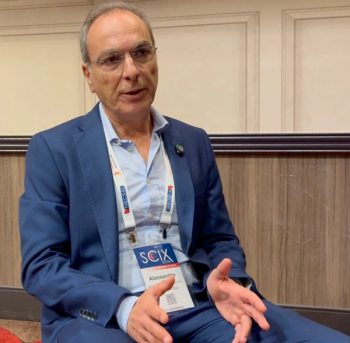
Siddhartha Das of the University of Maryland, winner of the AES Mid-Career Award, studies how ions and water interact at the atomic level in nanochannels grafted with polymer brushes, using all-atom molecular dynamics simulations. His group found that changing the polymer changes how ions distribute inside the brush layer.
At SciX 2026, Das sat down with Spectroscopy to talk about his research.1–4 Below is a text transcript of that conversation.
It means a lot to me. I did my PhD in this broad area of electrophoresis and electrokinetics. I started working in this area nearly 25 years ago when I was just a sophomore undergraduate student, and this topic has always excited me. So now to see this kind of recognition from such a well-respected society in this field really makes me feel very proud.
Also, to get a little bit technical here for this particular award, I think the credit has been given to two broad areas of research that I have kind of pioneered over the last 10–12 years as an independent faculty member at the University of Maryland. These two areas have both been related to electrokinetic transport and electroosmotic transport in channels that are functionalized by grafting with polymer chains. The first half of those works were basically beautiful mathematics. The second half of that work was very detailed simulations where we could simulate, for the first time in the world atom by atom, the entire system. We studied all the atoms of the polymers, all the atoms of the water molecules, all the atoms of the ions, and got something very fascinating. I think these two contributions have been recognized through this award, and that makes me really happy.
This is a very fundamental question. To understand the significance of what I discussed, I would like to give a very quick and brief background of what electroosmosis is. Electroosmosis is classically the electric field-driven liquid transport, or mostly water transport. But an electric field usually transports charges. Water has a dipole, but it's uncharged. So why is water getting transported if you apply an electric field? It happens because electroosmosis typically requires some added ions in the water, so that when you apply the electric field, the ions move, and the ions "carry the water molecules with them." That's what people have understood, and here lies the deep contribution that my talk is about.
In this electroosmosis, the key is how the ions interact with water, but nobody has looked into that great depth before about these interactions. We study those kinds of interactions between ions and water in a system where there are nanochannels grafted with these polymer chains, and those ions are either inside the polymer layer or outside the polymer layer. Depending on that, the ions have a particular kind of property, which in turn dictates how they pull the water. When you change the polymer, the ion behavior changes, the water motion changes, and therefore electroosmosis gets completely altered. The changes to electroosmosis that we see because of that are incredible. Such kinds of scenarios have never been seen. We can do this because we are talking about this kind of a water–ion interaction.
Here, the fundamental is how ion and water interact. This is where my research builds on. It looks into these fundamental issues associated with interactions of ion and water captured at the level of individual atoms, atom by atom. It was true for the polymer and its significance, and it’s the same with boron and graphene.
I can give a simple example. People fabricate what is known as holey graphene. They have these graphene sheets with tiny holes. How tiny? Some of them are 0.5 nm. To give you a sense of what this 0.5 nanometer is, think about our hair. Typically, the diameter of our hair strand is 70 microns, so imagine you are splitting that hair up into 100,000 parts, not along the length, but along the diameter. The diameter of one of those parts is basically the diameter of that hole, so you make a hundred thousand parts of that single hair strand. The diameter of that one hair strand is basically the diameter of the hole.
But how does that help in filtration and in desalination? For water, let's say you want to desalinate. So what do you need? You need the ions—that's the sodium and chloride—to be removed from water. But how would they get removed? When you bring that sodium chloride solution in contact with that graphene with the holes, water molecules are typically 0.3 nm and let's say the hole is 0.5 or 0.6 nm. Water molecules beautifully pass.
But what about the sodium and chloride? Now comes this whole idea of the ion–water interaction. Sodium and chloride ions cannot live in isolation. They're always surrounded by water, so the effective diameter of the sodium and chloride must include the additional water layer they have.
Therefore, in the presence of this additional water layer, sodium and chloride ions are typically around 0.7 nm. So now what do you have? You have a hole of 0.5 nanometer. A water molecule is 0.3 nanometer; it passes through it. At 0.7 nm are sodium and chloride with water; they can't pass. Therefore, what you now have is water passing, sodium and chloride remaining behind, and that's why you have the filtration. But fundamentally, we are still talking about water–ion interaction. The same water–ion interactions that we are probing for the case of this electroosmotic transport that we discussed.
So this was one of the most exciting moments of my professorial career to date when we saw those results because those results are such astonishing results. They were almost too good to be true, so I asked my students to check again, and we got the confirmation that is happening. And this reversal is happening because, depending on what polymer you are considering, the ion distribution inside that polymer layer varies, and that makes the water distribution and water motion in the presence of an electric field vary. This is what we had discovered, and that was the eureka moment, that this is what was happening, and this was something that only we could see. Why? Because we were looking at the level of ion–water interaction at this level of detail.
In terms of the experiments, this can be seen in experiments, but there are many steps to be taken before that because these are very complicated systems. These systems require very precise measurements and very precise fabrication. Unfortunately, the state of the art is not close to realize this experimentally. I'm hopeful within the next several years this would be possible. People are working on it, but it will take time.
Imagine I have a charged nanochannel, a nanochannel whose walls have charges. Now we apply a pressure-driven flow. Let’s say the ions move from left to right. Because there was some charged wall, there was some ion imbalance; effectively, this means that on my right-hand side, there are more of a particular type of ion as compared to the left-hand side. As a result, there's typically an electric field, from my right hand to the left hand. That electric field is called the streaming electric field, and this leads to an induced flow called the induced electroosmotic flow that reduces the overall flow. Now, let's say somebody wants to capture this flow reduction but doesn't want to account for this extra flow. What will that person do? They would say, "Okay, somehow the flow has become more viscous. That's why the flow is less." That's why it's called an electroviscous effect. Because this kind of an electric field is produced, that also leads to an energy production. Therefore, you have a scenario where energy is generated, but flow is reduced. This is the classical electroviscous scenario.
Now, coming back to our calculation, the electric field is from right to left. Great. So, what would it do? It will trigger a flow from right to left. Interestingly, we have discovered that the flow is driven by the ions; electroosmotic flow is driven by the ions of the same sign as the charged wall. Because of that, you will now have an electroosmotic flow, but not from right to left, but from left to right. So effectively, you now have both things happening. You have energy generation, and your overall flow becomes enhanced. This is remarkable because the classical idea is that if you gain something, you lose something. So, what were you gaining in the electroviscous case? You were gaining energy. What were you losing? The flow rate.
It's a win–win scenario, but the core concept is that it doesn't violate the second law of thermodynamics because this is happening due to a lot of dynamics. In addition, a lot of energy is pumped in because we now have an additional factor that under classical electroviscous effects is not there. So overall, the second law of thermodynamics is still satisfied, but you get this very unique scenario where you have both energy generation and flow enhancement together.
And when I saw that, it was an eureka moment in the lab.
Machine learning is another major tool in our system. All-atom molecular dynamics simulations generate a huge amount of data. To give you an idea, we have one million particles, and for each particle, we have data for one-million-time steps. So, you have one million, ten to the power six times ten to the power six, ten to the power of twelve, so it will be almost one trillion data with us. This is a huge amount of data, and this is a rich, fertile ground to see how we can work with this data.
With the existing machine learning tool or by combining several machine learning tools, we can get fantastic information about how water interacts with another water molecule through hydrogen bonding. Let's say we have a brush layer. We can see how their water–water hydrogen bonding is different inside the brush layer versus outside the brush layer. Similarly, it tells us that, if a particular kind of electroosmotic flow is not happening as per our intuition, machine learning helps us to quickly analyze and figure out the reason. Without machine learning, if we have to handle one trillion data and go through each data, you can understand the time it will take. Instead of that, if you subject that ten to the power twelve data to appropriate machine learning tools, we can quickly figure out the cause of this very new type of electroosmotic flow very quickly. So, these are two examples where machine learning can really help.
This interview transcript was lightly edited for clarity.