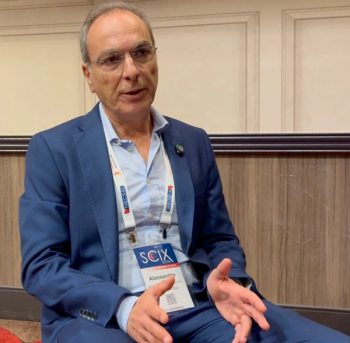
Marc Porter describes how his group’s surface science work led to SERS-based immunoassays, why reproducibility and pre-analytics decide whether a test reaches the clinic, and the questions he still wants to answer.
At SciX, Kevin Wilkinson of the Universite de Montreal explains how faster data acquisition and new software have cut analysis time and how a particle’s chemical composition can link arsenic-bearing emissions back to a copper refinery’s processes.
In an interview at SciX 2026, which took place in Sparks, Nevada, Kevin Wilkinson, a professor of environmental chemistry at the Université de Montréal, discusses how improvements in instrumentation and data processing have changed the way he approaches particle analysis, and what the chemical composition of particles measured near a copper extraction facility reveals about emissions from the site.
Over the past decade, Wilkinson said, the most significant instrumental change has been the speed at which spectroscopic techniques acquire data, which is a development he describes as entirely helpful to his work. Equally important has been the progress in handling the large data sets these measurements produce.
Data treatment has improved by orders of magnitude in just the past few years. Previously, a day of laboratory analysis would be followed by roughly two weeks of data crunching. With recent software advances, that same day of analysis now requires only two to three days of data processing. The result, Wilkinson explained, is more efficient data treatment and a better understanding of what is being measured. In turn, the faster turnaround is yielding sharper insights into the samples themselves.
Wilkinson then turns to findings from measurements taken outside a copper extraction facility. That the particles contained little to no copper was expected, he noted, since the facility’s purpose is to remove copper from its feedstock. The more revealing result lies in the elemental combinations found within individual particles. Because the refinery draws on both recycled materials and ores as inputs, particles carrying elements from both sources point directly to the process itself, whether released through the stack or as fugitive emissions.
These process-derived particles are significant for several reasons. They tend to be smaller, they are often where the arsenic is located, and they are the ones that tend to be transported away from the facility. Characterizing particles by their chemical composition, Wilkinson says, helps researchers understand which emissions originate from the refinery and how they may spread beyond its boundaries.
(1) Wilkinson, K.; Workman, J., Jr.; Wetzel, W. Kevin Wilkinson on Tracing Airborne Metal Pollution Particle by Particle. Spectroscopy Online, 2026.