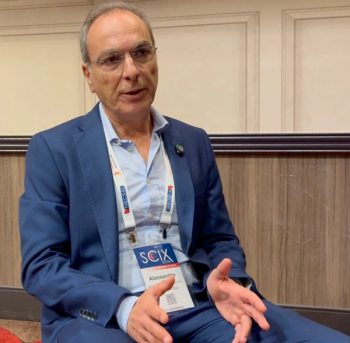
At SciX, Marc Porter explains how a Thanksgiving batting lesson led him to compare a bat meeting a ball to light scattering off a molecule, and how his group is using simulations to test whether the analogy holds.
Marc Porter describes how his group’s surface science work led to SERS-based immunoassays, why reproducibility and pre-analytics decide whether a test reaches the clinic, and the questions he still wants to answer.
Marc Porter is a Distinguished Professor Emeritus in Chemistry and Chemical Engineering at the University of Utah, and he was the recipient of the ACS Division of Analytical Chemistry Award in Spectrochemical Analysis. He was recognized at SciX 2026 for this accomplishment.
As part of Spectroscopy’s coverage of the conference, we sat down with Porter for an interview. During our conversation, he reacted describes how his group’s surface science work led to surface-enhanced Raman spectroscopy (SERS)-based immunoassays, why reproducibility and pre-analytics decide whether a test reaches the clinic, and the questions he still wants to answer.
Marc Porter says the news of his recent award was hard to put into words. His first two reactions were “wow,” but he is quick to share the credit with the students, postdocs, and colleagues whose ideas and hard work shaped his group’s research.
Porter, formally trained as an electrochemist, traces his group’s move into bioanalytical chemistry to the mid-1990s, when it was studying organic monolayers on gold. Two of his students pushed the group to apply its surface-characterization expertise to immunoassays. After a six-month trial testing gold nanoparticles and polymeric particles, the gold-based
According to Porter, SERS has in many cases outperformed fluorescence and other immunoassay formats in limits of detection and analytical sensitivity. Clinical translation exposed new problems. In a tuberculosis test developed with collaborators at the University of Utah and Colorado State University, detection fell by three to four orders of magnitude in human serum because the target marker was bound up in protein complexes. An acid-denaturation step solved the problem chemically but was unacceptable for clinical labs. The team switched to a proteinase K pretreatment that yields serum results statistically indistinguishable from buffer. A company in England is now exploring commercialization.
Porter says reproducibility at picomolar and femtomolar levels remains the biggest challenge.
Looking ahead, Porter is developing a baseball analogy for Stokes and anti-Stokes scattering. He is also preparing a proposal to determine where the hydrogen goes when alkanethiols adsorb on gold, and pondering how close analytical chemists can get to detecting a single molecule in a liter. He is also involved in Litmus Analytical, a startup building a field-deployable PFAS test.
(1) Porter, M.; Workman, J., Jr.; Wetzel, W. Marc Porter on SERS Immunoassays, Raman Labels, and a 95-mph Fastball. Spectroscopy Online, 2026.