SPEC PerkinElmer 11.10
News|Articles|March 4, 2025

Spectroscopy’s Evolutions Highlighted at Pittcon 2025

Author(s)Aaron Acevedo

Pittcon 2025, and this year’s sessions discussing spectroscopy, are currently underway, allowing analytical scientists, newcomers and veterans alike the opportunity to discuss the latest findings and research with their peers. In this preview, we discuss some of the many upcoming workshops available to attendees that will provide new insights into spectroscopy.

On Tuesday, March 4, from 9:50–10:10 AM, Takayuki Oka of Kyoto University (Kyoto, Japan) will present “Aggregation Properties of Liquid Crystalline Organic Semiconductors in Thin Film Revealed by Infrared Spectroscopy” as part of the session titled “PAI-NET Cutting-edge IR Spectroscopy for Studying Organic Thin Films, Sensing Surfaces and Material Recycles.” Known for having excellent performances as p-type semiconductors for organic thin-film transistors. 2-Alkyl-7-phenyl[1]benzothieno[3,2-b][1]benzothiophene, otherwise known as Ph-BTBT-Cn can be further enhanced through thermal annealing via transformations of the molecular packing structure. However, alkyl chain conformation can depend greatly on general temperature, meaning that the conformational change of alkyl side chains of Ph-BTBT-Cn should correlate with the temperature-dependent crystal transitions including the liquid crystal phase (1). Though crystal transitions in thin films have been revealed previously using X-ray diffraction (XRD), molecular aggregation structures, including alkyl side chain conformation, have not been fully clarified. With this study, Ph-BTBT-Cn thin films were prepared by spin coating or vapor deposition and analyzed by infrared Brewster’s angle transmission (IR-BAT) spectroscopy. Efforts were focused on the CH2 antisymmetric stretching vibration band of the alkyl chain to investigate the chain conformation. In addition, the molecular orientation in the Ph-BTBT-Cn films is revealed by using p-polarized multiple-angle incidence resolution spectrometry (pMAIRS). Oka’s presentation will be in room 109B.

That same day, from 10:10–10:30 AM, Marisia Fikiet of the University of New Haven (New Haven, CT) will present “Investigating Counterfeit Cannabis Edibles Using Vibrational Spectroscopy” as part of the half session “Forensic Analysis of Controlled Substances” (2). As legal cannabis rises in popularity and laws are created to govern its use, counterfeit cannabis edible products, including high quality, low quality, diverted, and burner distro (product sold out the backdoor to the black market), have become available to consumers. The product qualities of different genres of counterfeit goods have not been scientifically investigated; as such, this study was conducted to utilize established methods for analyzing counterfeit pharmaceutical and cannabis products to develop an optimized analytical scheme that effectively distinguishes counterfeit products from genuine ones. Two different edible product types were examined, gummies and chocolate. It was found through the analysis that attenuated total reflectance-Fourier transform infrared spectroscopy (ATR FT-IR), was especially useful for examining and revealing information about the packaging materials, which can then be employed in counterfeit cannabis investigations (2). Fikiet’s presentation will be in Room 207.

On Wednesday, March 5, from 10:40–11:10 AM, Conor Evans of Massachusetts General Hospital (Boston, MA) discusses the pharmacological potential of coherent Raman scattering (CRS) microscopy in his presentation “Coherent Raman Scattering Imaging as a Quantitative Tool for Pharmacology,” part of the session “Spectroscopy and the Role it Plays in the Successful Development and Deployment of Modern Biopharmaceutical Medicines”(3). CRS microscopy can offer a label-free means of visualizing specific molecules and their effects in tissue, which theoretically makes the approach well-suited for solving drug development challenges. With this study, Evans and his team combined CRS imaging with novel hyperspectral approaches, data science, and deep learning methods for the automated and quantitative analysis of drug products both in dosage formats and within tissue (3). These approaches were validated and tested on various drugs under several formulations; thus, this study is aimed to demonstrate how CRS imaging tools can reveal new, previously inaccessible pharmacokinetic information. Evans’ presentation will be held in Room 206B.

To learn more about Pittcon 2025 and other scheduled workshops, visit the event’s online schedule page. We at Spectroscopy will also continue our coverage of the field’s latest discussions at this year’s conference.

References

(1) Oka, T. Aggregation Properties of Liquid Crystalline Organic Semiconductors in Thin Film Revealed by Infrared Spectroscopy. Pittcon 2025. https://labscievents.pittcon.org/event/pittcon-2025/planning/UGxhbm5pbmdfMjQ1NDA2Mw== (accessed 2025-3-3)

(2) Fikiet, M. Investigating Counterfeit Cannabis Edibles Using Vibrational Spectroscopy. Pittcon 2025. https://labscievents.pittcon.org/event/pittcon-2025/planning/UGxhbm5pbmdfMjQ1MzE1MQ== (accessed 2025-3-3)

(3) Evans, C. Coherent Raman Scattering Imaging as a Quantitative Tool for Pharmacology. Pittcon 2025. https://labscievents.pittcon.org/event/pittcon-2025/planning/UGxhbm5pbmdfMjQ1Mzc1Nw== (accessed 2025-3-3)



Related to this article

Spectroscopy Top 10 DOI Articles of the Month (September 2026)
The following articles are the most accessed digital object identifier (DOI) manuscripts for Spectroscopy and LCGC International during the month of September 2026. Nine articles are individually ranked here by DOI page views; the third-highest entry (186 views) was recorded against the bare journal-level DOI rather than an individual article and is therefore not attributable to a single manuscript.
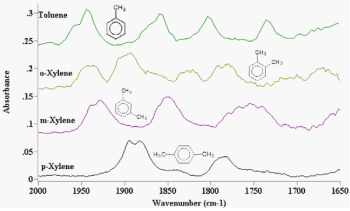
Highly Substituted Benzene Rings—The Rest of the Story II: Spectra
This column, the second installment on highly substituted benzene rings, shows that tri- and tetra-substituted substitution patterns can be distinguished by whether the ring bending peak is present and by the position of the in-phase aryl C-H wagging peak, which shifts according to how many adjacent hydrogens the ring carries.
Healthcare administrator reviewing an insurance policy schedule with a stethoscope on a clipboard, health insurance coverage, medical underwriting, prior authorization, and patient claims processing. | Image Credit: Joi_studio - stock.adobe.com
In a SciX interview, Marc Porter covered a lot of ground, from a student-driven pivot into immunoassays to a baseball analogy for Stokes and anti-Stokes scattering, and shares the open questions he is still chasing.
Ingots of pure copper or pink gold on a black background. | Image Credit: Phawat - stock.adobe.com
At SciX, Kevin Wilkinson of the Universite de Montreal explains how faster data acquisition and new software have cut analysis time and how a particle’s chemical composition can link arsenic-bearing emissions back to a copper refinery’s processes.