

Laser-induced breakdown spectroscopy (LIBS) is being used in numerous application areas, including environmental monitoring, cultural heritage, and space exploration.
Alessandro De Giacomo is a professor at the University of Bari Aldo Moro in Italy and the Editor-in-Chief of Spectrochimica Acta Part B: Atomic Spectroscopy (SAB). His research centers on laser-induced breakdown spectroscopy (LIBS) and the physics of laser-induced plasmas, including nanoparticle-enhanced LIBS for trace analysis and applications in environmental monitoring, cultural heritage diagnostics, and space exploration. As SAB’s Editor-in-Chief, De Giacomo organizes an annual SciX session honoring the three best papers published in the journal each year; the 2026 session recognizes those papers’ authors. He will also present separately in this year’s SciX Innovation Award session introducing a fully operational in-flight LIBS system, mounted on a drone, capable of quantitative elemental analysis.
Laser-induced breakdown spectroscopy (LIBS) is being used in numerous application areas, including environmental monitoring, cultural heritage, and space exploration.
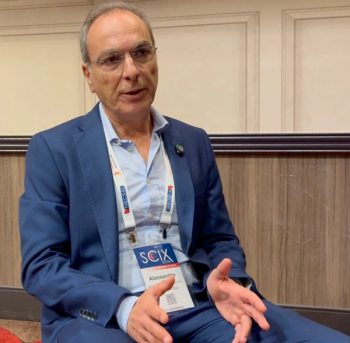
In an interview at SciX, Alessandro De Giacomo discusses nanoparticles as signal enhancers and medical tags, a self-calibrating drone LIBS system, open questions in laser–matter interaction, and why students need a strong foundation in fundamentals.
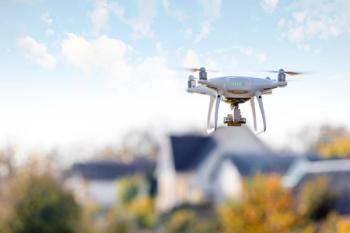
At SciX, Alessandro De Giacomo explained how airborne LIBS can produce quantitative results. Instead of relying on reference measurements, the method draws calibration directly from the measured signal, which sidesteps the drone’s positioning and motion problems.

Alessandro De Giacomo argues that grounding students in scientific fundamentals, rather than rushing them toward applications, is what makes breakthrough ideas possible.
At SciX, Alessandro De Giacomo explains how a 35-member international jury chose three papers: one on correct ICCD use and two applications using LIBS and LA-ICP-MS. He also explains what the selections say about the field.
At SciX 2026, Alessandro De Giacomo explains why laser–matter interaction deserves more attention and how nanoparticle size forces a trade-off between sensitivity and practical tagging.
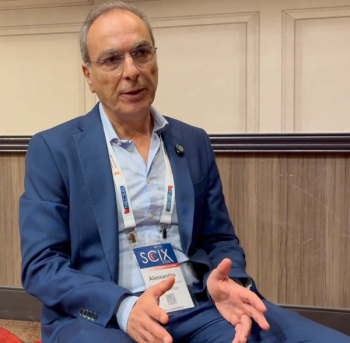
Honored with a dedicated Spectrochimica Acta Part B award session at SciX 2026, De Giacomo explains why larger nanoparticles produce stronger LIBS signals and what that means for sensing design.