The inaugural Peter Griffiths Award winner discusses deep low-frequency Raman measurements through wax and what remains before clinical breast-imaging use.
At SciX 2026, Alessandro De Giacomo explains why laser–matter interaction deserves more attention and how nanoparticle size forces a trade-off between sensitivity and practical tagging.
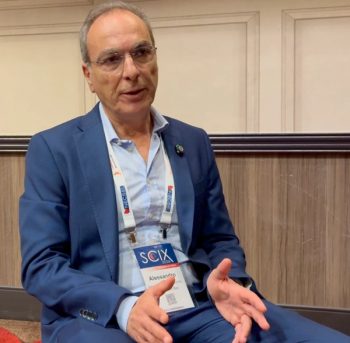
In an interview with Spectroscopy Magazine at SciX 2026, which took place in Sparks, Nevada, Alessandro De Giacomo, a professor at the University of Bari Aldo Moro in Italy and a longtime editorial board member of Spectrochimica Acta Part B: Atomic Spectroscopy, shared his perspective on where gaps remain in the understanding of
According to De Giacomo, the scientific community has developed a strong grasp of the plasma itself. What remains less understood, he said, is the laser–matter interaction that initiates the process and the mechanism by which material is ejected from the sample. He emphasized that the system is not homogeneous. Instead, it is heterogeneous, with a gas plasma phase coexisting and interacting with a condensed phase throughout the plasma’s evolution. This interplay, he noted, has received far less attention than conventional plasma characteristics, and he argued that it deserves greater focus from the research community going forward.
De Giacomo also addressed the role of
That advantage comes with constraints when nanoparticles are used as tags for biological targets. De Giacomo pointed to exosomes as an example: these particles can measure around 100 nanometers or even smaller, so the size of the tag itself can physically interfere with the target. Researchers must therefore select a nanoparticle that can effectively tag the system of interest without that interference. The challenge grows in multiplex analysis, where several tags are applied at once; in those cases, large nanoparticles are not a practical option.
Ultimately, De Giacomo described nanoparticle selection as a balancing act. The right choice depends on the type of tagging being performed, weighing the sensitivity gains offered by larger particles against the practical limits imposed by the size of the target and by the number of tags the analysis requires.
(1) De Giacomo, A.; Workman, J., Jr.; Wetzel, W. Alessandro De Giacomo on LIBS, Plasma Physics, and Nanoparticle Size. Spectroscopy Online, 2026.