
Sponsored Content
This eBook provides a deeper dive into the benefits of applying a ‘Total Workflow’ approach to sample prep for elemental analysis and the tools and methods that can be used to achieve those benefits.
Sponsored Content
This eBook provides a deeper dive into the benefits of applying a ‘Total Workflow’ approach to sample prep for elemental analysis and the tools and methods that can be used to achieve those benefits.
Sponsored Content
Learn how to apply a ‘Total Workflow’ approach to sample preparation for elemental analysis. Leading to increased lab productivity, better data quality, lower costs, and improved safety.
Sponsored Content
This white paper offers guidance on selecting the optimal microwave technology for the unique demands of pharmaceutical and dietary supplement matrices, as outlined in USP Chapter <233>.
Sponsored Content
In this industry report, a recovery study was performed on certified reference materials and spiked samples to demonstrate the efficacy of ultraWAVE 3 in the preparation of mixed samples from 0.5 g to 2 g in a single digestion run.
Sponsored Content
This Technology Report describes the design and construction advances implemented in ultraWAVE 3, along with the practical impacts these advances have on the productivity, performance, safety, user experience, and costs of operation and ownership of the system in analytical laboratories.
Sponsored Content
In this report we study the robustness of the “Total Sample Preparation approach,” which includes use of SRC technology, to achieve and in some cases surpass the new detection level requirements proposed by the Baby Food Safety Act of 2021 and US FDA’s “closer to zero” plan.
Sponsored Content
This industry report describes how a challenging batch of Platinum Group Element samples were able to be digested simultaneously and completely due to the unique performance characteristics of the Milestone ultraWAVE 3
Sponsored Content
This industry report shows how three common lithium battery-related sample matrices (Li-ores, anodes, and cathodes) were digested simultaneously using Milestone's SRC technology.
Sponsored Content
Guidance on selecting the optimum microwave technology for the unique demands of pharmaceutical and nutraceutical matrices, as outlined in USP Chapter <233>.

Sample digestion with the Milestone ultraWAVE takes around one hour including cool-down time.
Realize up to 90% cost savings by purifying low-cost reagent grade acids to produce the high-purity acids needed for the lowest ICP-MS detection limits.
Sponsored Content
Learn how to select the most appropriate microwave digestion technology for determining trace and heavy metals via ICP-OES and ICP-MS.
Sponsored Content
Learn how to select the most appropriate microwave digestion technology for determining trace and heavy metals via ICP-OES and ICP-MS.
Sponsored Content
Learn how to select the most appropriate microwave digestion technology for determining trace and heavy metals via ICP-OES and ICP-MS.
Single Reaction Chamber (SRC) technology to simplify and optimize food and mixed-food microwave sample preparation for trace metal analysis using ICP-MS is described.
This app note describes the Hg analysis of fish and animal tissue without any sample preparation and using a single, matrix-independent calibration.
Realize up to 90% cost savings by purifying low-cost reagent grade acids to produce the high-purity acids needed for the lowest ICP-MS detection limits.
Realize up to 90% cost savings by purifying low-cost reagent grade acids to produce the high-purity acids needed for the lowest ICP-MS detection limits.

Sponsored Content
In this webcast we will review current analytical methods as well as necessary microwave sample preparation techniques to enhance efficiency and accuracy for the modern food lab.
Achieve high performance and high throughput within a single rotor-based platform.
Application Notebook
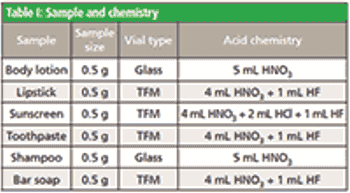
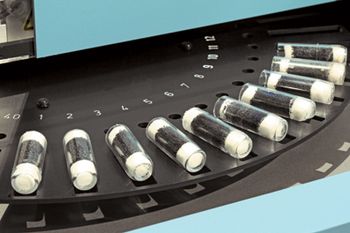
Milestone's UltraWAVE microwave digestion system with single reaction chamber (SRC) technology, enables the simultaneous digestion of up of to 22 different sample types and chemistries at temperatures and pressures as high as 300 ?C and 199 bar.
Application Notebook
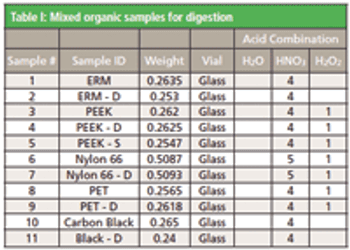
Sample matrices with high organic content have created a significant challenge for sample preparation methods.
Spectroscopy
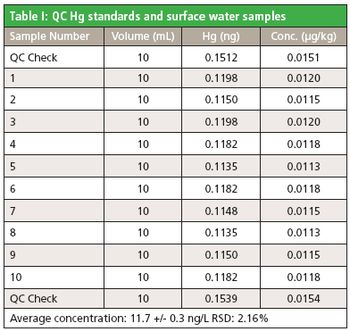
With over 1300 commercial testing labs in the United States, one out of every three samples is for water analysis. There has been an even stronger emphasis on mercury testing and its concentration in our water supplies.
Application Notebook
Direct mercury analysis is ubiquitous in analytical labs within the environmental, petrochemical, and specialty chemicals industry for analyzing mercury in solids and liquids.
Application Notebook
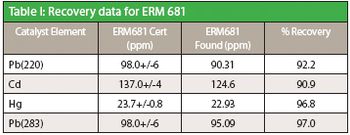
Single reaction chamber microwave digestion enables a chemist to digest up to 15 different specialty chemical samples simultaneously at temperatures as high as 300 ?C, greatly simplifying the workflow while maintaining superior quality digestions.

February 1st 2022
June 6th 2024
September 14th 2023
November 13th 2020
June 10th 2024