
ICP-MS

Latest News


i4-697443-1416911321005.jpg

The determination of elements in oils and petroleum products is important to refineries, industrial processes, machinery, and transports. This article explores the analysis of fuel oils using ICP-MS for the routine determination of elements at low concentration levels in both clean and dirty fuel oil samples.

i4-697447-1408635101758.jpg

The determination of trace metals in volatile organic solvents is of utmost importance to prevent catalyst poisoning and final product contamination. This article discusses the need for the analysis of trace metals in volatile organic solvents and reviews the challenges and problems that have been traditionally associated with this type of analysis when performed using inductively coupled plasma-mass spectrometry (ICP-MS). A new method is highlighted, combining ICP-MS with an advanced dual syringe pump sample introduction system. The unique capabilities of the technique to deliver direct, efficient, accurate, and contamination-free analysis of trace metals in volatile organic solvents are demonstrated in an application example.

i1-576644-1408666100955.jpg

The coupling of HPLC with ICP-MS is a relatively new technique that combines two very well established analytical methods. The combination of these analytical methods provides what could prove to be a very useful technique in clinical analysis. The total LC-ICP-MS market amounts to only a few percent of the overall ICP-MS market, but it is rapidly developing into a significant niche market.

i4-549180-1408669228840.gif

Research regarding detection of chemical warfare agents has become vital for finding solutions that will help reduce the threat of these substances. This article looks at the use of collision cell ICP-MS for the analysis and detection of organophosphorus agents.

While inductively coupled plasma-mass spectrometry (ICP-MS) is capable of part-per-quadrillion (ppq) detection limits under ideal conditions, most applications do not require this level of sensitivity and do not justify the cost associated with achieving it. Practical sensitivity in ICP-MS is determined not by instrument signal-to-noise ratio, but rather by controlling interferences and matrix effects in real samples. Understanding the sources of these effects and their management is critical in determining the most practical way to achieve specific data quality objectives.

i4-515921-1408652476800.jpg

In drug discovery, determining information about the extent of metabolism and the elucidation of metabolite structures is a vital step for lead optimization and drug scaffold refinement. The identification and characterization of metabolites plays an important role in both the drug discovery and development phases, as unsuitable pharmacokinetics (bioavailability and drug distribution), toxicity, and adverse drug reactions might be linked to metabolic instability. Historically, metabolite identification was carried out after a compound had been chosen for drug development. However, to reduce candidate failures attributed to toxicity effects, many pharmaceutical companies now conduct these experiments in the earliest phases of candidate drug selection.

i9_t-515917-1408652488106.gif

Specific purity requirements are set for water sources, whether we deal with waste, ground, surface, or drinking water. Water quality is key, and it is becoming a focal point for an increasing number of communities worldwide. Water quality determines the use of a body of water such as for manufacturing, farming, fishing, and human consumption. The reason to strive to maintain or improve a given body of water is to preserve or upgrade its quality, because once this quality degrades, so does its value.

i8_t-515920-1416913552874.jpg

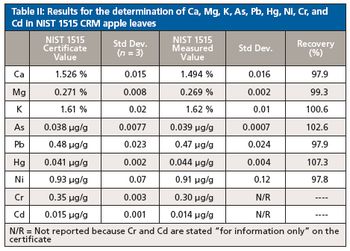
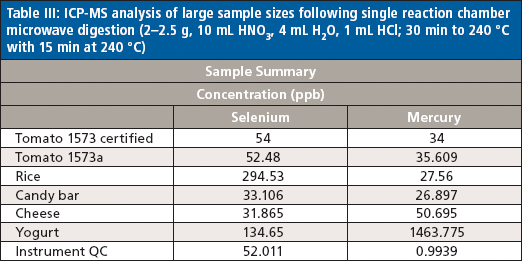
The determination of inorganic elements in food substances is critical for assessing nutritional composition and identifying food contamination sources. The inorganic elements of interest can be divided into two classes: nutritional and toxic. It is important to determine the levels of both sets of elements accurately to assess both the nutritional and the harmful impacts of food substances. Nutritional elements such as Mg, P, and Fe are present at high levels (milligrams per kilogram), while toxic elements such as Pb, Hg, and Cd should be present only at trace levels (nanograms or micrograms per kilogram).

i4-515916-1408652491707.gif

Detrimental health effects of a group of brominated flame retardants, polybrominated diphenyl ethers (PBDEs), have been recognized recently, but only after their wide usage and consequently, global dispersal. Of the possible 209 PBDE congeners, 39 (varying in degree of bromination from mono to deca) have been identified previously in the three common technical mixtures. Additional congeners, presumably debromination products of the fully brominated decabromodiphenyl ether (BDE-209), also have been reported in biotic and abiotic environments. However, costly analytical standards are needed to confirm their identification. In addition, the most widely used identification approach, electron ionization (EI) mass spectrometry (MS), primarily produces spectra indicating only homologue grouping (for example, hepta-BDE). Without specific compound identification, full assessment of toxicological consequences of PBDE burdens is impeded. It has been reported previously that electron-capture negative ionization (ECNI),..

Speciation analysis has grown rapidly and has expanded to a variety of markets, including environmental, clinical, food, nutraceutical, and bioanalytical. This growth has resulted from the realization that knowing the total amount of an element does not always provide adequate information for assessing health and environmental effects, but knowing which form of the element is present presents a much more comprehensive picture.

i4-505086-1408663703076.jpg

Gas chromatography and comprehensive two-dimensional gas chromatography with time-of-flight mass spectrometry (GC–TOFMS and GCxGC–TOFMS) were utilized to develop trace-level calibration curves in brewed green tea spiked with organochlorine and organophosphorus pesticide standards. A sensitive and robust calibration curve was developed from 10 to 500 parts per trillion (ppt), which allowed quantitative results to be determined for organochlorine–organophosphorus pesticides in brewed green tea. Exceptional limits of detection were achieved by GC–TOFMS and GCxGC–TOFMS at or below 10 ppt (solution concentration) for all but one of the pesticides. Stir bar sorption extraction (SBSE) was utilized to isolate the pesticide components from brewed green tea samples prior to analysis by GC–TOFMS and GCxGC–TOFMS. Different types of green tea were analyzed qualitatively by SBSE and GC–TOFMS with subsequent quantification for organochlorine–organophosphorus..

i4-505113-1408663687506.jpg

Beta-blockers are basic compounds that contain a secondary amino group in their structure. The amino substituents are typically an isopropyl group and a larger chain with a hydroxyl group in the beta position from the nitrogen atom (Table I). The simultaneous analysis of ?-blockers in biological samples is meaningful, and is made possible by the similarities in their structure. Gas chromatography (GC)–mass spectrometry (MS) has been the most used technique for their identification and quantification (4–6). However, most ?-blockers are nonvolatile and thus require derivatization via a cumbersome and time-consuming process before GC–MS analysis. In recent years, liquid chromatography (LC) coupled with mass spectrometric detection has evolved as the method of choice for drug analysis in the pharmaceutical, clinical, and forensic toxicology areas (4–8). In contrast to GC–MS, LC–MS-MS generally does not require derivatization and offers superior sensitivity. Moreover, due to the high specificity offered by LC–MS-MS, baseline chromatographic resolution often is not required, allowing for fast analysis in high-throughput environments.