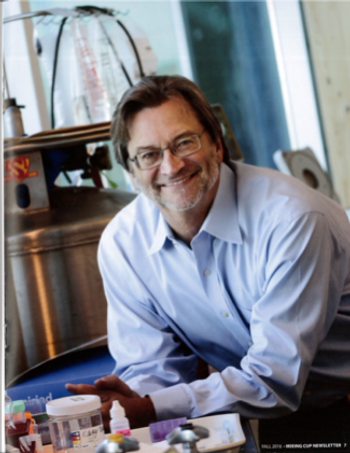
Now, batter up. Marc Porter, Distinguished Professor Emeritus at the University of Utah, outlined a baseball analogy to describe Raman scattering. He got the idea from his brother’s hitting lessons at a family Thanksgiving. Think of photons as pitches. Some balls come off the bat slower, some faster, and they head to different fields. That’s Stokes and anti-Stokes scattering. Absorption is a catch, and fluorescence is a catch and a throw. Porter’s group is now simulating bat–ball collisions that are starting to look like Raman spectra, with results expected within months.2
Our new “Spectral Frontiers” column reports that chip-scale sensors are shrinking FT-NIR instruments into embeddable parts, handheld analyzers are expanding grain and food testing, and hyperspectral imaging is moving toward process analysis.3 Noninvasive glucose monitoring, though, remains elusive.
Finally, September’s top article, by Howard Mark and Jerome Workman, Jr., on decimal versus binary numbers, drew nearly triple the views of the runner-up, and Brian C. Smith’s polymer infrared series claimed four spots.4
Find all of these stories at spectroscopyonline.com. That’s the Best of the Week. Thanks for reading, and we’ll see you next week.
References
- De Giacomo, A.; Workman, J., Jr.; Wetzel, W. Why Spectroscopy Education Should Aim for Revolution, Not Evolution. Spectroscopy Online, 2026. https://www.spectroscopyonline.com/view/why-spectroscopy-education-should-aim-for-revolution-not-evolution (accessed October 19, 2026).
- Porter, M.; Workman, Jr., J.; Wetzel, W. Stepping Up to the Plate: A Baseball Analogy for Raman Scattering. Spectroscopy Online, 2026. https://www.spectroscopyonline.com/view/stepping-up-to-the-plate-a-baseball-analogy-for-raman-scattering (accessed October 19, 2026).
- Workman, J., Jr. The Overtone Frontier: Chip-Scale Sensors, Chemometrics, and the Long Chase for Noninvasive NIR Diagnostics. Spectroscopy Online, 2026. https://www.spectroscopyonline.com/view/the-overtone-frontier-chip-scale-sensors-chemometrics-and-the-long-chase-for-noninvasive-nir (accessed October 19, 2026).
- Workman, J., Jr. Spectroscopy Top 10 Articles of the Month (September 2026). Spectroscopy Online, 2026. https://www.spectroscopyonline.com/view/spectroscopy-top-10-articles-of-the-month-september-2026 (accessed October 20, 2026).