News|Videos|July 31, 2026

Best of the Week: Upcoming Spectroscopy Conferences, University Archaeometry Programs

Author(s)Will Wetzel

Top articles published this week include an inside look at university archaeology programs and a couple previews of two Spectroscopy-focused conferences that are upcoming.

Archaeometry is a popular subject and discipline students pursue in college, but one thing that isn’t always apparent in this subject is that university programs teach skills that are transferable to other disciplines. Our published “Pathways in Spectroscopy” clip this week expands on this. Also, the American Chemical Society (ACS) Fall 2026 Meeting, the 2027 European Winter Conference on Plasma Spectrochemistry, and the Eastern Analytical Symposium (EAS) are coming up later this year.1–4

This is the Best of the Week.

First up: archaeometry. It's a popular field for students to pursue in college, but here's something that isn't always obvious: the skills these programs teach go far beyond archaeology. In our latest “Pathways in Spectroscopy” interview, Mary Kate Donais of Saint Anselm College breaks down how archaeometry, which is the use of scientific techniques like spectroscopy to study artifacts and ancient materials, builds skills that transfer directly into forensic science.1 Both fields demand careful handling of irreplaceable samples and sharp comparative analysis, so students walk away with real-world problem-solving experience and advanced spectroscopic techniques that open doors across multiple careers.1

Next, we're looking ahead to the ACS Fall 2026 Meeting, where Lai-Sheng Wang of Brown University will present on boron nanoclusters. Wang's research uses photoelectron spectroscopy and computational chemistry to explore boron's unique behavior at the nanoscale, including how small boron clusters favor flat, planar shapes, work that helped pave the way for the discovery of borophene.2 He'll also cover the first confirmed boron fullerene, B40, and how these structures shift from two-dimensional (2D) to three-dimensional (3D) as they grow.2

Finally, we're previewing the Eastern Analytical Symposium (EAS) one of the longest-running conferences in analytical chemistry. Taking place November 16 through 18 in Plainsboro, New Jersey, EAS 2026 will feature technical symposia, workshops, an instrument exposition, and awards spanning analytical chemistry, spectroscopy, chemometrics, and mass spectrometry (MS), plus its Young Investigator Award for rising talent in the field.4

That's your Best of the Week. Thanks for watching, thanks for reading, and we’ll see you next week.
References
  1. Donais, M. K.; Wetzel, W. Are University Archaeology Programs Preparing Students for Employment Effectively? Spectroscopy Online, 2026. https://www.spectroscopyonline.com/view/are-university-archaeology-programs-preparing-students-for-employment-effectively- (accessed July 28, 2026).
  2. Wetzel, W.; Spectroscopy Staff. What Are the Latest Advancements in Boron Nanocluster Research? Spectroscopy Online, 2026. https://www.spectroscopyonline.com/view/what-are-the-latest-advancements-in-boron-nanocluster-research- (accessed July 28, 2026).
  3. Wetzel, W.; Spectroscopy Staff. Athens to Host 21st European Winter Conference on Plasma Spectrochemistry in February 2027. Spectroscopy Online, 2026. https://www.spectroscopyonline.com/view/athens-to-host-21st-european-winter-conference-on-plasma-spectrochemistry-in-february-2027 (accessed July 28, 2026).
  4. Wetzel, W.; Spectroscopy Staff. Previewing the Upcoming 2026 Eastern Analytical Symposium. Spectroscopy Online, 2026. https://www.spectroscopyonline.com/view/previewing-the-upcoming-2026-eastern-analytical-symposium (accessed July 29, 2026).

Related to this article

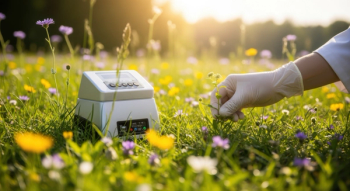
Scientist With Portable Spectrometer in Natural Field Setting ©  By Tika -chronicles-stock.adobe.com
The bulky bench-top NIR spectrometer is quietly being dismantled and rebuilt as a wafer-scale photonic chip, a self-calibrating algorithm, and a sensor small enough to ride in a shirt pocket. What once demanded a grating, a moving mirror, and a climate-controlled lab now fits inside a handheld module, a bioreactor probe, or a drone payload, and it increasingly figures out what it is looking at on its own.
Sizing Up the Nanoscale: Measuring Nanocluster Aerosol in Indoor Air
In the first part of a multi-part Q&A, Brandon Boor, the Dr. Margery E. Hoffman Associate Professor in the Lyles School of Civil and Construction Engineering at Purdue University, describes the instrumentation and methodology behind measuring nanoparticle size distributions at the nanocluster scale (1–3 nm) and outlines the technical challenges of acquiring reliable, real-time data at these dimensions.
Human body wireframe on glowing platform undergoing futuristic body scan. © sergray(noAIelemens) -chronicles-stock.adobe.com
Jurgen Popp, Thomas Mayerhofer, and colleagues at Leibniz IPHT and Friedrich Schiller University Jena introduce the Personalized Optical Digital Twin (PODT), a Photonics21 contribution to Europe's Virtual Human Twin ecosystem that connects molecular photonics—Raman blood analysis, coherent Raman tissue imaging, and multimodal endomicroscopy—with longitudinal physiology and clinical data. Drawing on the published multicenter INTELLIGENCE trials, the authors argue that technical feasibility and clinical utility must be evaluated separately as the field moves toward Europe's FP10 research agenda.