In this podcast, Dr. Adam J. Hopkins and Dr. Max Ma share their perspectives on key things to look for when deciding on a Raman spectrometer. They explore how the Raman system configuration is determined by what needs to be measured, where, and when.
A recent conversation with Kevin Wilkinson, a professor of environmental chemistry at the Université de Montréal, sheds light on why no single signature can separate engineered nanoparticles from natural ones.
Top articles include the publication of a new terminology guide focused on data processing, machine learning, artificial intelligence (AI), and chemometrics.
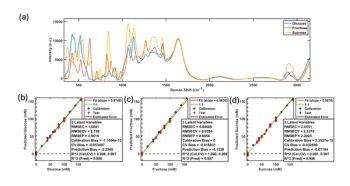
This column shows that a Raman plate reader paired with partial least squares regression can simultaneously quantify glucose, fructose, sucrose, and ethanol in yeast fermentation samples, using turbidity-matched calibration standards to correct for yeast-induced turbidity, and offers a rapid, label-free, high-throughput method for tracking sugar consumption and ethanol production in strain screening, media optimization, and process development.
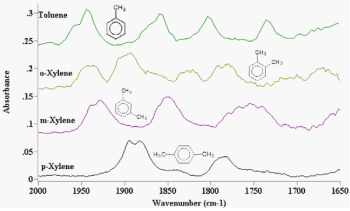
This column, the second installment on highly substituted benzene rings, shows that tri- and tetra-substituted substitution patterns can be distinguished by whether the ring bending peak is present and by the position of the in-phase aryl C-H wagging peak, which shifts according to how many adjacent hydrogens the ring carries.
How do ions and water interact at the atomic level in nanochannels grafted with polymer brushes using all-atom molecular dynamics simulations? Siddhartha Das of the University of Maryland and his team are working on answering this question.
In a SciX interview, Marc Porter covered a lot of ground, from a student-driven pivot into immunoassays to a baseball analogy for Stokes and anti-Stokes scattering, and shares the open questions he is still chasing.
Laser-induced breakdown spectroscopy (LIBS) is being used in numerous application areas, including environmental monitoring, cultural heritage, and space exploration.