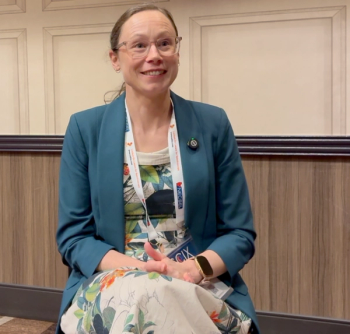
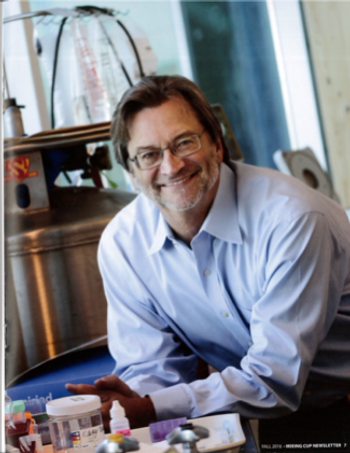
He also noted an unexpected benefit of leaving a traditional academic role. Kitt said he had worried about losing the teaching side of academia, but he now mentors two colleagues, one with a doctorate and one who recently completed a bachelor’s degree in chemical engineering, and said he is doing more mentoring now than he did in a chemistry department.
Kitt’s second area of interest grew out of a SciX talk he attended roughly a decade ago, in which a Purdue University group described stimulated Raman methods for identifying cancer borders during surgery, potentially reducing the need for surgeons to send tissue sections to pathology. Kitt reasoned that if vibrational spectra can distinguish healthy from cancerous tissue, they must also carry information about what is happening inside those cells.
The obstacle, he said, was interpretation: assigning meaning to amide modes, protein–phospholipid interactions, DNA structure, and hydrogen-bonding effects remains difficult. With mature instrumentation now widely available, Kitt sees machine learning and AI as tools for mining the literature and running correlation analyses to link specific band changes to biological meaning, positioning Raman spectroscopy to move in a powerful new direction.
Further Reading
- Kitt, J.; Workman, J., Jr.; Wetzel, W. Jay Kitt Named Spectroscopy's 2026 Emerging Leader in Molecular Spectroscopy. Spectroscopy Online, 2026. https://www.spectroscopyonline.com/view/jay-kitt-named-spectroscopy-s-2026-emerging-leader-in-molecular-spectroscopy (accessed October 14, 2026).