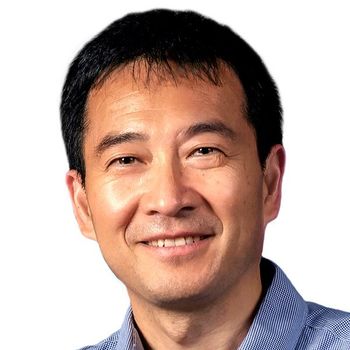
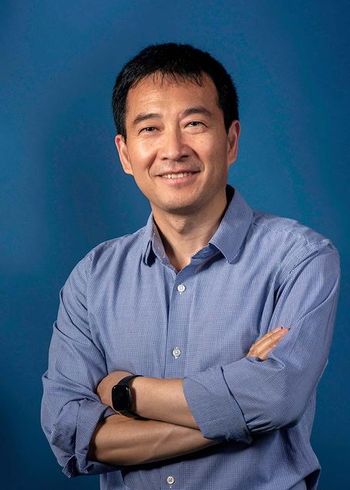
At the SciX 2026 Conference, there will be an award session to recognize Siddhartha Das, a professor at the University of Maryland, for winning the AES Mid-Career Award. As part of the award plenary, Das will deliver a 30-minute talk on Wednesday October 7th at 8:30 am titled, “Electroosmosis in Soft Nanochannels Probed Using a Combination of Molecular Simulations and Machine Learning.”1,2
What will Das’s AES Mid-Career Award presentation cover?
In his presentation, Das will discuss his group’s molecular simulation and machine learning (ML) results that describe unexpected electroosmotic flow behavior in nanochannels lined with charged polymer brushes.2 The findings Das will present include how flow reverses direction as the electric field strengthens and flow strengths that scale non-linearly.2
Why are charged nanochannel walls important to study?
To understand why charged nanochannel walls are important to study, it’s important to know what an electric double layer is. This is an unbalanced layer of ions that charged nanochannel walls often attract.2 Under an applied or induced electric field, these mobile charges move and drag the surrounding fluid.2 This process is known as electroosmosis, and it is the subject of Das’s talk. The presentation will focus on the "soft" nanochannels, whose walls are grafted with charged polyelectrolyte chains, or brushes.2
In his presentation, Das will explain how his group used atomistic molecular dynamics simulations to study channels grafted with anionic poly(acrylic acid) (PAA) brushes and sodium counterions.2
What did the atomistic molecular dynamics simulations reveal?
There were three phenomena Das and his team noted. The first was the overscreening of the brush layer.2 The second was an excess of coions outside the brush that drives the flow.2 And the third was a reversal in flow direction when the electric field is increased.2
Das and his team also examined pressure-driven flow in PAA-grafted channels. There, the coion-driven electroosmotic transport is induced by the flow itself rather than by an applied field.2 What this produces is an "electroslippage" effect, in which electrokinetic energy is generated while the flow is enhanced.2
What were the results of the study?
Das will highlight the two main findings from his team’s work. The first finding was that the team observed field-dependent flow reversal, which suggests the direction of transport could be tuned by adjusting the electric field.2 The second finding is the coupling of energy generation with flow enhancement in pressure-driven channels.2 The comparison between anionic poly(acrylic acid) (PAA) and cationic [poly(2-(methacryloyloxy)ethyl) trimethylammonium] (PMETA) brushes also shows how sensitively transport depends on the solvation behavior of the grafted groups.2
What is the AES Mid-Career Award Das is being recognized for?
The AES Mid-Career Award is an annual award given out by the AES Electrophoresis Society. The award honors outstanding contributions to electrophoresis, microfluidics, and related fields by someone in the middle of their career.3
The AES Electrophoresis Society formed in the year 1972, and it has belonged to the Federation of Analytical Chemistry and Spectroscopy Societies (FACSS) since 2012.3 The society's mission is to advance and promote electric field-mediated separations, manipulations, and related phenomena, with a focus on electrophoresis and electrokinetic techniques.3
The AES Mid-Career Award is one of the several awards that will be given out at the SciX Conference. This year’s SciX Conference will take place in Sparks, Nevada. You can read more about the upcoming conference here: https://www.spectroscopyonline.com/view/previewing-the-upcoming-2026-scix-conference.
References
- Wetzel, W.; Spectroscopy Staff. Previewing the Upcoming 2026 SciX Conference. Spectroscopy Online, 2026. https://www.spectroscopyonline.com/view/previewing-the-upcoming-2026-scix-conference (accessed September 18, 2026).
- Das, S. Electroosmosis in Soft Nanochannels Probed Using a Combination of Molecular Simulations and Machine Learning. Presented at the SciX 2026 Conference, Sparks, Nevada, October 7, 2026. Available at: https://www.scixconference.org/onlineprogram
- SciX Conference, AES Electrophoresis Society Awards. SciX Conference, 2026. https://scixconference.org/AES-Electrophoresis-Society-Awards (accessed September 18, 2026)