
Perkin Elmer
Advertisement
Articles by Perkin Elmer
Webcasts
Tuesday March 22nd 2022 at 11 am EDT | 8 am PDT | 3 pm GMT Join this webinar to learn about recent methods for the direct analysis of trace elements in seawater, leveraging the benefits of proven ICP-MS technologies for challenging matrices, including multi-quadrupole technology, which provides the added benefit of interference-free analysis, ideal for open-ocean seawater matrices, where trace elements are even lower than in coastal areas.
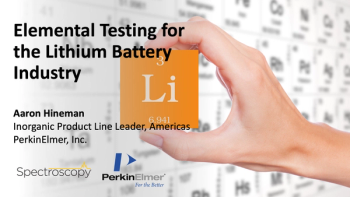
Lithium (Li) plays an important role in everyday life and can be found around us in nearly every aspect of modern living. One of the most common uses of lithium is in batteries. Lithium batteries can be found in cell phones, computers, electric vehicles, and every portable electronic device. With the demand for higher-capacity batteries, current battery production technology must improve, requiring better control of the elemental composition of the raw materials and components used. Atomic spectroscopic techniques, such as atomic absorption (AA), inductively coupled plasma optical emission spectrometry (ICP-OES), and inductively coupled plasma mass spectrometry (ICP-MS) are used for a variety of analyses in the Li supply chain and battery industry. In this podcast we will explore a range of applications where these analytical techniques are used to further improve battery performance and safety.
Sponsored Content
PerkinElmer’s LPC 500™-Avio® 550 Max ICP-OES integrated solution enables the same diluted sample to be analyzed for multi-element determination and particle count in a single run.
Sponsored Content
Monitor additive levels, corrosion metals, and contaminants in accordance with ASTM D6130. PerkinElmer’s Avio® 550 Max ICP-OES provides accurate multi-element determination and more.
Sponsored Content
PerkinElmer's Avio® 550 Max ICP-OES accurately measures low levels of phosphorus, sulfur, copper, and iron in accordance with European Standard IP 581.
Sponsored Content
PerkinElmer's Avio® 560 Max ICP-OES performs rapid 60-second sample-to-sample analysis per EPA Method 200.7, thanks to its fully simultaneous capabilities and built-in HTS.
Sponsored Content
See how continuous flow-hydride generation on PerkinElmer's Avio® 220 Max ICP-OES with a single pre-reduction technique allows simultaneous measurement of both elements.
Sponsored Content
Analyzing high-concentration elements? PerkinElmer’s Avio® 220 Max ICP-OES performs accurate, stable analyses of plating bath solutions, with Attenuation mode and auto-integration.
Sponsored Content
For the analysis of major elements in lithium ore, PerkinElmer’s Avio® 550 Max ICP-OES provides equivalent results to flame AA, with multi-elemental analysis, and more.
Sponsored Content
Analyzing batteries for major components and impurity levels? PerkinElmer’s Avio® 550 Max ICP-OES delivers extremely high precision, performing true simultaneous measurements.
Webcast
*Live: Tuesday, June 8, 2021 at 11am EDT| 8am PDT| 4pm GMT|5pm CET* Don’t miss the opportunity to discover how key software and hardware technologies can help reduce turnaround time and improve your results. *On Demand Until June 8, 2022*
***Live: Tuesday December 8th, 2020 at 11am EST| 8am PST| 4pm GMT|5pm CET*** Don’t miss the opportunity to learn about the benefits of multi-quadrupole ICP-MS and its superior interference removal capabilities for routine applications requiring robust and reliable analyses, such as geochemical samples from a fusion preparation as well as impurities in high-purity metals and rare earth elements. *** On demand available after final airing until Dec. 8, 2021.***
Sample preparation and analysis of metals in disposable, non-medical face masks with the Avio® 550 Max ICP-OES to meet the criteria defined in ISO 18562- 4:2017.
Sponsored Content
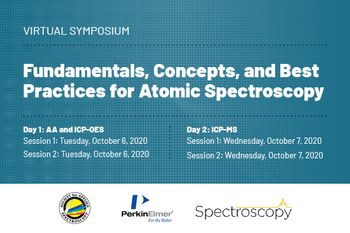
Spectroscopy, in collaboration with the Society of Applied Spectroscopy (SAS) and PerkinElmer, is hosting a free two-day virtual symposium. It is a focused on online learning clinic designed to improve your knowledge about instrumentation, theory, and practice in the use of atomic spectroscopy techniques. Live: Session 1: Tuesday, Oct. 6, 2020 10:00 am–12:00 pm EDT Session 2: Tuesday, Oct. 6, 2020 1:00–2:30 pm EDT Session 3: Wednesday, Oct. 7, 2020 10:00 am–12:00 pm EDT Session 4: Wednesday, Oct. 7, 2020 1:00–2:30 pm EDT On demand available after airing until Oct. 7, 2021
Advertisement
Advertisement
Advertisement
Trending on Spectroscopy Online
1
CNN-Enhanced Hybrid Spectral Comparison Using HQI in a Learned Feature Space
2
Advancements and Applications in FT-IR Spectroscopy
3
Highlights from What’s Nu August 2026
4
Pathways in Spectroscopy: Pursuing a Career as a Space Scientist
5