



Spectroscopy
A detailed guide to interpreting the infrared spectra of organic nitrogen compounds, including secondary and tertiary amines.
Spectroscopy
A detailed guide to interpreting the infrared spectra of organic nitrogen compounds, including secondary and tertiary amines.
Spectroscopy
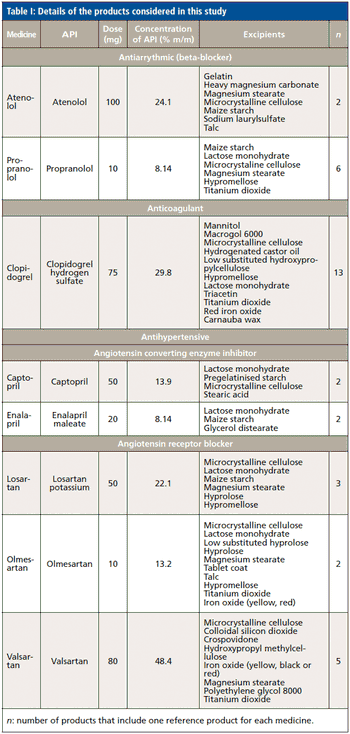
Portable NIR spectroscopy is demonstrated as a rapid and mobile analysis method for authenticating cardiovascular medicines in critical situations, and to indicate whether formulations are counterfeit or substandard.
Spectroscopy
Aromatic esters follow the ester Rule of Three, but each of these three peak positions is different for saturated and aromatic esters, which makes them easy to distinguish. Organic carbonates are structurally similar to esters and follow their own Rule of Three.
Spectroscopy
Esters are a common and economically important functional group made by reacting an alcohol and a carboxylic acid.
Spectroscopy
Carboxylates are made by reacting carboxylic acids with strong bases such as inorganic hydroxides. Carboxylates contain two unique carbon–oxygen “bond and half” linkages that coordinate with a metal ion to give two strong infrared peaks, which make them easy to see.
Spectroscopy
Acid anhydrides are unique in that they have two carbonyl groups in them. The intensity and position of their IR peaks can be used to determine which of the four types of anhydride exist in a sample.
Spectroscopy
How to spot carboxylic acids in your IR spectra
Spectroscopy
Aldehydes feature a unique “lone hydrogen” atom, giving rise to unique C-H stretching and bending peaks, making them easy to spot. In this installment, a new feature is also presented, “IR Spectral Interpretation Review,” where key concepts from past columns are presented for those new to the column and for readers who need a refresher.
Spectroscopy
An introduction to the IR spectroscopy of the carbonyl group, exploring why the peak is intense and showing how to apply that knowledge to the analysis of the spectra of ketones

In forensic science, the detection of blood on fabric is a very useful tool. Therefore, it is important that the methods used for detecting blood be as accurate as possible. Michael L. Myrick and Stephen L. Morgan, both professors in the Department of Chemistry and Biochemistry at the University of South Carolina, have been investigating the use of infrared (IR) spectroscopy for this purpose, including comparing the effectiveness of infrared diffuse reflectance versus attenuated total reflectance Fourier-transform IR (ATR FT-IR). They recently spoke to Spectroscopy about their recent studies and the critical questions they have been addressing in how IR spectroscopy is used in forensic science.
Special Issues
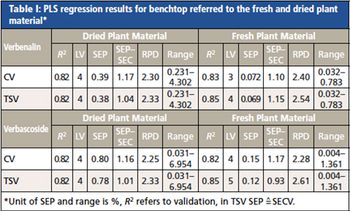
This work shows that methods based on miniaturized near- and mid-infrared spectroscopy can be used effectively for the quality control of herbal medicines.
Special Issues
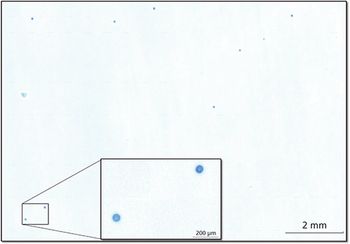
Microplastics from clothing, abrasive action on plastics, or engineered microbeads as found in some exfoliating cosmetics are showing up in many environmental systems. FT-IR microscopy is a useful tool in the analysis of microplastics, providing visual information, particle counts, and particle identification.

Special Issues
Naoto Nagai focuses on solving problems for industry. In this interview, he explains his research to determine the cause of resin cracks in polyoxymethylene mold plates using IR spectroscopy.
Spectroscopy
Two unrelated discussions are presented: carbohydrates and alkynes.
Coherent two-dimensional infrared spectroscopy (2D IR) uses a series of IR femtosecond laser pulses to pump and then probe the response of a system, making it possible to learn much more about the structure and dynamics of molecules than can be seen with one-dimensional IR spectroscopy. The technique’s inventor, Martin T. Zanni of the University of Wisconsin-Madison, discussed 2D IR in a 2013 interview in Spectroscopy (1). Since 2013, Zanni has applied 2D IR spectroscopy to new systems and has started a company, PhaseTech Spectroscopy, Inc., to commercialize the technique.
Spectroscopy
We will discuss three different types of ether, which are characterized by the type of carbons attached to the central oxygen.
Spectroscopy
In addition to primary alcohols there exist secondary and tertiary alcohols.
Spectroscopy
We now turn our attention to the C-O bond, how to detect its presence in a sample from an infrared (IR) spectrum, and a study of the functional groups that contain this bond. In this first installment on the topic, we study the spectra of alcohols and learn to distinguish primary, secondary, and tertiary alcohols from each other based on their infrared spectra.
Spectroscopy
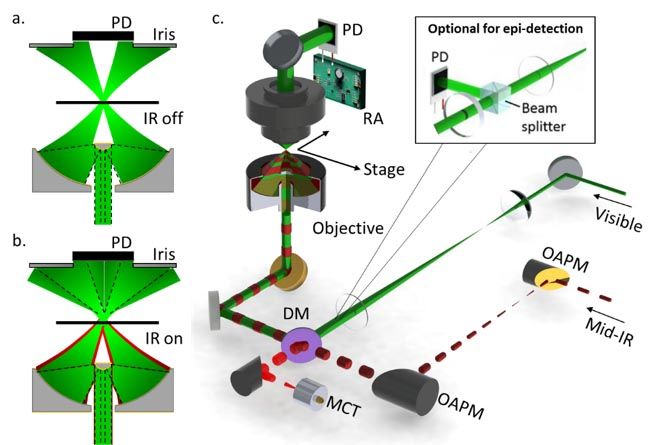
Mid-infrared (MIR, 3-20 µm) sensor platforms are increasingly adopted in chem/bio analytics, and applied in areas ranging from process monitoring to medical diagnostics. Due to the inherent access to molecule-specific fingerprints via well-pronounced fundamental vibrational, rotational, and roto-vibrational transitions, quantitative information at ppm to ppb concentration levels and beyond is achievable in solids, liquids, and gases. In particular, the combination of quantum cascade lasers (QCLs) with correspondingly tailored waveguide technologies serving as optical transducers – thin-film waveguides for liquid/solid phase analysis, and substrate-integrated hollow waveguides for gaseous samples – facilitates miniaturizable and integrated optical chem/bio sensors and diagnostics applicable in, e.g., exhaled breath analysis, food safety, and environmental monitoring.
Spectroscopy
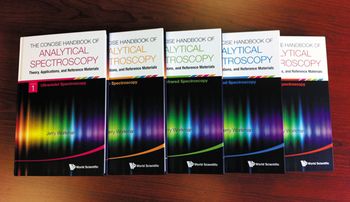
Heinz W. Siesler, Emeritus Professor at University of Duisburg-Essen, reviews Jerry Workman’s new book, The Concise Handbook of Analytical Spectroscopy Theory, Applications, and Reference Materials
Spectroscopy
Advances in spatial resolution for Fourier transform infrared (FT-IR) imaging historically have involved the use of a synchrotron source, but new optics have been developed that yield better spectral quality and spatial resolution than are provided by existing synchrotron sources. Kathleen Gough, Professor in the Department of Chemistry at the University of Manitoba, has been working with her group to conduct diagnostic tissue imaging with the new thermal source FT-IR system. She recently spoke to us about these efforts.
Spectroscopy
Now that we have completed our discussion of benzene rings and the infamous “benzene fingers,” the next topic on our hydrocarbon hit parade are carbon-carbon double and triple bonds. C=C bonds, otherwise known as alkenes, come in six different structural isomer types, while triple bonds, known as alkynes, come in two varieties. This column provides you with all the tools you need to distinguish all of these different types of molecules from each other.
Spectroscopy
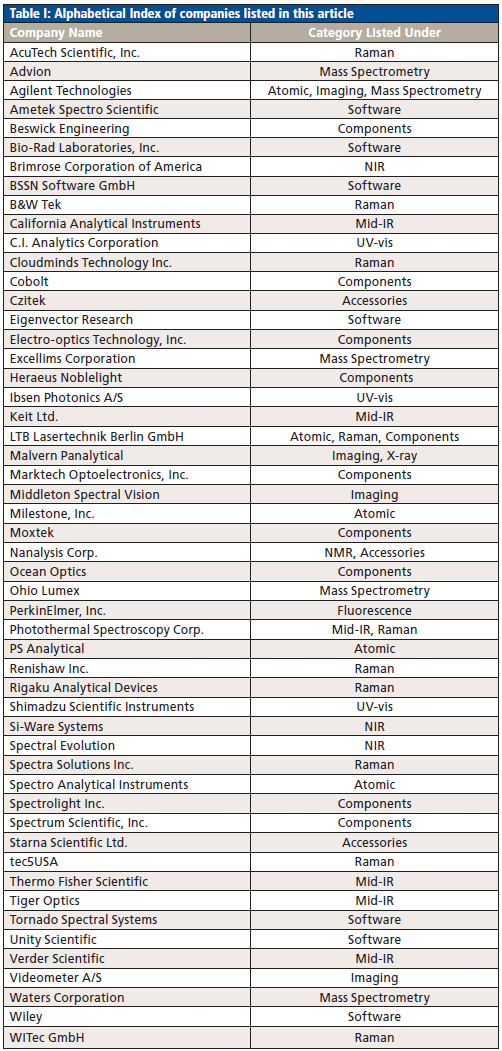
Infrared reflectance and absorption spectroscopy have been practiced for decades. New capabilities in detectors and light sources are quickly changing the landscape in the near- and mid-infrared, where fundamental vibrations and overtone bands allow sensitive measurements in applications related to food safety, precision agriculture, energy, and smart manufacturing, to name a few. This article outlines some of the most recent innovations and how they might be applied in real-world systems.
Spectroscopy
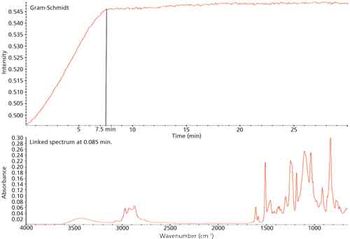
Adhesives are a group of materials that are found extensively in manufacturing and production industries and are of great interest for quality control and failure analysis. This paper discusses the use of an array detector in conjunction with ultrafast mapping to produce kinetic chemical imaging to monitor the curing process in a two-part epoxy resin. This technique allows for simultaneous analysis of both the kinetics of the epoxy reaction along with the spatial information of the reaction. This kinetico-spatial information gives insight about localized domains that form when the epoxy is mixed and how the reaction progresses.
Spectroscopy
With the theoretical background of benzene analysis laid out in part 1 of this series, we now know what fundamental, overtone, and combination bands look like. Here, I show that the benzene fingers are a series of overtone and combination bands that can be used to distinguish substituted benzene rings from each other when other methods do not work. I review the benzene finger patterns for mono-, ortho-, meta-, and para- substituted benzene rings, and describe an easy mnemonic in which you use your fingers to help you remember the patterns.