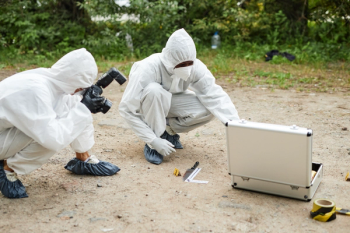
Over the past two years, molecular spectroscopy has undergone a marked transformation from a predominantly laboratory-based analytical approach into a field-deployable, data-rich forensic toolkit. This evolution has been driven by three converging trends: (i) advances in vibrational spectroscopic instrumentation (Fourier transform infrared [FT-IR], Raman, and near-infrared [NIR], (ii) the integration of chemometrics and machine learning for extracting actionable information from complex spectra, and (iii) the emergence of portable and miniaturized devices suitable for in situ analysis. The ten papers reviewed here collectively demonstrate how spectroscopy is now addressing some of the most persistent challenges in forensic science—such as time since deposition (TSD), post-mortem interval (PMI), trace evidence discrimination, and rapid drug identification—while maintaining evidentiary integrity through non-destructive analysis. Importantly, these works also reflect a shift toward interpretability, validation, and legal defensibility, which are essential for courtroom acceptance.