New Low-Cost Fluorescent Probe Offers Rapid Detection of Toxic Hydrazine in the Environment and Food
Researchers from Jiangnan University introduced a sensitive, selective, and highly adaptable new probe for detecting hydrazine.

Researchers from Jiangnan University introduced a sensitive, selective, and highly adaptable new probe for detecting hydrazine.

Researchers at the Sinopec Research Institute have developed a novel method using virtually generated mid-infrared spectra to accurately quantify plastic blends, offering a faster, scalable solution for recycling and environmental monitoring.

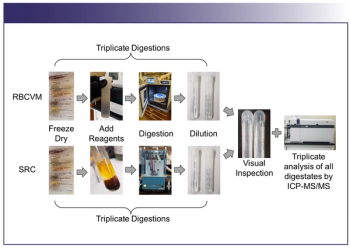
In Part II of our conversation with James Harrington of RTI International in Research Triangle Park, North Carolina, who was the lead author of this study, as well as coauthor Donna Seibert of Kalamazoo, Michigan, they talk about the reproducibility for Hg and V, as well as the ICP-MS and XRF results compare to one another.

Spectroscopy sat down with James Harrington of Research Triangle Institute (RTI International) in Research Triangle Park, North Carolina, who was the lead author of this study, as well as coauthor Donna Seibert of Kalamazoo, Michigan. In Part I of our conversation with Harrington and Seibert, they discuss the impact of ICH Q3D and United States Pharmacopeia (USP) <232>/<233> guidelines on elemental impurity analysis and how they designed their study.

Our “Chemometrics in Spectroscopy” column highlights the methodology that is used in order to apply chemometric methods to data. Integrating chemometrics with spectroscopy allows scientists to understand solutions to their problems when they encounter surprising results. Recently, columnists Howard Mark and Jerome Workman, Jr., wrote a series of articles about data transforms in chemometric calibrations. In this listicle, we profile all pieces in this series and invite you to learn more about applying chemometric models to continuous spectral data.

A recent astronomical study saw a research team from Argentina study an open star cluster using spectroscopy instrumentation.

A new study in the Journal of Food Composition and Analysis showcases high-performance detection using artificial intelligence and spectroscopy.

Researchers at Harbin Medical University recently developed a SERS-based diagnostic platform that uses DNA-driven “molecular hooks” and AI analysis to enable real-time detection of cardiovascular drugs in blood while eliminating interference from larger biomolecules.

Researchers in South Korea demonstrate a fast and reliable method for measuring lithium isotope abundance using dual-laser plasma technology.

Researchers from Kannur University and Anand Niketan College have developed Dy³⁺-doped TiO₂ nanoparticles with unique luminescent properties using a novel solvothermal method.

In this “Icons of Spectroscopy” column, Spectroscopy Executive Editor Jerome Workman, Jr. explores the life and contributions of Albert Abraham Michelson, a graduate of the United States Naval Academy, who showed early brilliance in physics and mathematics, eventually resulting in a teaching position at the Academy and the Nobel Prize in Physics in 1907.

Top articles published this week include an announcement from Waters Corporation, a news story about the hidden geology of the Big Island of Hawaii, the latest “IR Spectral Interpretation” column, which focuses on analyzing carbonyl compounds, and wearable spectroscopy sensors.

New predictive models promise to revolutionize livestock feeding strategies in one of China’s most important pastoral regions.

A new study published in Chemosphere by researchers at Bharathidasan University reveals alarming seasonal microplastic (MP) contamination in fish and shellfish from India's Pichavaram Mangroves.

Researchers from the University of Nevada, Reno, have conducted the most comprehensive subsurface analysis of Hawaiian shield basalts to date, using advanced spectroscopic and geochemical techniques to reveal short-lived hydrothermal alteration processes and establish a new foundation for future volcanic and geothermal studies.

A new study led by Ayanjeet Ghosh of the University of Alabama presents a transformative approach to analyzing infrared (IR) imaging data, with promising implications for neurodegenerative disease research.

Researchers from James Cook University highlight critical gaps and future directions for developing a large-scale, machine-learning-based satellite spectroscopy system to monitor sugarcane health and detect diseases and pests.

This product review covers products introduced from May 2024 to April 2025.

In a press release on Tuesday May 6th, 2025, Waters Corporation, an analytical instrument, separations technology, and software manufacturer, announced several updates to its Empower software.

A recent review article highlights the promise of near-infrared (NIR) spectroscopy for on-farm analysis of liquid organic manure.

In this edition of “Inside the Laboratory,” Johanna Nelson Weker of SLAC National Accelerator Laboratory discusses her laboratory’s work in battery analysis. In the final part of our interview, Weker continues our discussion of battery cell geometries and why computed laminography is a good technique to use for this purpose.

Carbonyl containing functional groups are strong infrared absorbers and a number of them are easy to identify by infrared spectroscopy. Here, we will review the spectra of ketone and carboxylic acids.

A new study published in Geoderma Regional by J. A. Arias-Rios and colleagues at IFAB demonstrates that near-infrared (NIR) spectroscopy is a rapid, cost-effective tool for assessing soil and tree traits critical to forest ecosystem monitoring and management.

In Part 3 of our conversation with Johanna Weker of SLAC National Accelerator Laboratory, she discusses battery cell geometry configurations and how they inform battery design.

In this extended Q&A interview, we sit down with Kelsey Williams, a postdoctoral researcher at Los Alamos National Laboratory (LANL), who is working on planetary instrumentation using spectroscopic techniques such as laser-induced breakdown spectroscopy (LIBS) and laser ablation molecular isotopic spectrometry (LAMIS). In the final part of our conversation with Williams, she discusses how laser-based spectroscopic techniques might be used in the future to advance space exploration.

In this extended Q&A interview, we sit down with Kelsey Williams, a postdoctoral researcher at Los Alamos National Laboratory (LANL), who is working on planetary instrumentation using spectroscopic techniques such as laser-induced breakdown spectroscopy (LIBS) and laser ablation molecular isotopic spectrometry (LAMIS). In Part III, Williams goes into detail about ChemCam and SuperCam and how LIBS is used in both these instruments.

In this extended Q&A interview, we sit down with Kelsey Williams, a postdoctoral researcher at Los Alamos National Laboratory (LANL), who is working on planetary instrumentation using spectroscopic techniques such as laser-induced breakdown spectroscopy (LIBS) and laser ablation molecular isotopic spectrometry (LAMIS). In Part II of our conversation with Williams, she talks about the potential of mass spectrometry (MS) in space exploration applications.

Top articles published this week include interviews from our National Space Day content series, a news story about satellite-based spectroscopy, and an interview about battery analysis conducted at SLAC National Accelerator Laboratory.

Join us in celebrating National Space Day! Today, Spectroscopy magazine is teaming up with the Society for Applied Spectroscopy (SAS) to honor National Space Day and highlight the latest advancements in space exploration.

Research was conducted exploring the dehydration pathways of gypsum (CaSO₄·2H₂O) and its interactions with chloride (Cl) salts under a range of thermal and environmental conditions relevant to Earth and Mars.Spectroscopy spoke to Merve Yeşilbaş, corresponding author of a paper based on this work (1), about the research.