

All News
Advertisement

A recent study developed and tested a highly stable, nanozyme-based colorimetric sensor capable of rapidly and accurately detecting vitamin C in commercial beverages, offering a practical tool for real-time nutritional assessment.

A new study led by Gaëlle Belleau-Magnat at Université de Sherbrooke reveals that Arctic gossans, analyzed using rover-compatible techniques, may serve as valuable analogs for Martian environments and help guide the search for past life on Mars.

In a 2025 study, Indian researchers demonstrated that combining near-infrared (NIR) spectroscopy with aquaphotomics enables rapid, non-destructive detection of adulterants in honey by analyzing changes in water’s spectral behavior. Using chemometric models, they accurately identified and quantified six common adulterants, offering a powerful tool for food authenticity and quality control.

Researchers from Université de Montréal have demonstrated that a new handheld Raman spectroscopy device, the UltraProbe, can accurately and rapidly detect retroperitoneal soft tissue sarcomas during surgery, offering real-time tissue analysis that could improve surgical outcomes.

Horiba, Ltd. announced that David Birch, PhD, who is an Emeritus Professor at the University of Strathclyde and the co-founder of Horiba Jobin Yvon IBH Ltd., has been elected as an Honorary Fellow of the Institute of Physics (IOP), the organization's top recognition

This is a brief tutorial review on the use of the Raman OH stretching bands of water for biomedical applications.

Researchers in Bangladesh have developed a rapid, non-destructive method to detect honey adulteration using UV-Vis-NIR spectroscopy paired with machine learning. Their findings could protect consumers and support food quality enforcement.

A new study used advanced techniques, including µ-Raman spectroscopy and machine learning, to map and predict microplastic pollution on São Paulo’s urban beaches.

A new review article highlights the growing use of random forest machine learning (ML) models in biomedical signal analysis, emphasizing their potential for detecting cell damage, assessing toxicity, and advancing diagnostic classification.
Advertisement
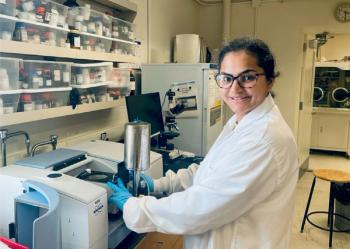
Spectroscopy spoke to Shreya Singh of Cornell University, author of a recent article dealing with using DRIFTS for the photocatalytic conversion of CO₂.

A recent study demonstrated that portable Raman spectroscopy, combined with advanced statistical modeling, offers a reliable, non-destructive method for monitoring nitrate levels in greenhouse-grown spinach.

A new study has confirmed the presence of multiple microplastic types in human amniotic fluid using a dual-method approach, raising concerns about potential long-term impacts on fetal development.

Near-Infrared Spectroscopy for Honey Authentication: A Practical Mini-Tutorial for Food Quality Labs
This tutorial introduces how NIR spectroscopy works for honey analysis, explores practical workflows, discusses real-world applications, and outlines best practices for implementing this technique in food labs.

A new bibliometric study published in Infrared Physics & Technology highlights the growing global impact of near-infrared (NIR) spectroscopy in biofuel research, revealing key trends, contributors, and future directions for advancing sustainable energy solutions.

Top articles published this week include a feature article about big pharma’s investments in U.S.-based manufacturing, an article about the 2025 Emerging Leader in Molecular Spectroscopy Lingyan Shi, and some news items detailing the winners of the Coblentz Society’s student awards.

In a recent announcement, the Coblentz Society, an organization committed to promoting and nurturing young scientists to pursue vibrational spectroscopy, announced that Steven Quarin, a student at the University of Cincinnati, is this year’s recipient of the William G. Fateley Student Award.

A new review published in Trends in Food Science & Technology highlights how advanced spectroscopy, multidimensional chromatography, artificial intelligence (AI), and novel sensors are improving food safety by enhancing sensitivity, speed, and sustainability in contaminant detection.

A multi-billion-dollar drug manufacturing hub focused on chronic diseases will be established in Virginia, supported by new facilities across California, Indiana, Maryland, Massachusetts, and Texas.

Mississippi State University researchers show that mid-infrared (MIR), a.k.a. infrared (IR), portable spectrometers, combined with calibration transfer techniques, can match lab instruments for soil property analysis.

A recent study presented a simple correction method that significantly improved the accuracy of Transmission Raman Spectroscopy by mitigating spectral distortions caused by tablet thickness, porosity, and compaction force.

Growing U.S.-based drug manufacturing is creating new demands—and opportunities—for analytical chemists.

The Coblentz Society, a nonprofit organization dedicated to fostering the application and understanding of vibrational spectroscopy, announced the winners of its 2025 student awards.

German researchers have demonstrated a portable Raman laser system that analyzes soil composition directly in agricultural fields, offering precise, real-time data for precision farming.

Researchers at INIAV in Portugal have demonstrated that near-infrared (NIR) spectroscopy combined with chemometric algorithms offers a rapid, non-destructive, and accurate method for detecting harmful fumonisins in maize, enhancing food safety monitoring.

Researchers at China Agricultural University developed a rapid and accurate spectroscopic method using NIR and FT-IR combined with PLS regression to measure protein content in rice noodles, enhancing quality control for the popular river snail rice noodle (luosifen) industry.

Spectroscopy's 2025 Emerging Leader in Molecular Spectroscopy is Lingyan Shi of the University of California, San Diego. Shi’s research focuses on developing and applying molecular imaging tools, including stimulated Raman scattering (SRS), multiphoton fluorescence (MPF), fluorescence lifetime imaging (FLIM), and second harmonic generation (SHG) microscopy.

A team from the University of Cordoba demonstrated that a portable near-infrared spectral sensor can accurately assess olive oil quality, offering a practical, low-cost alternative to laboratory methods.

This study presents a new system that enables the precise detection of glucose, choline, and lactate without traditional labels or antibodies.

A recent study unveiled a new adaptive Raman spectroscopy and transformer-based model for fast, high-accuracy microbial classification.
Advertisement
Advertisement