Application Notebook
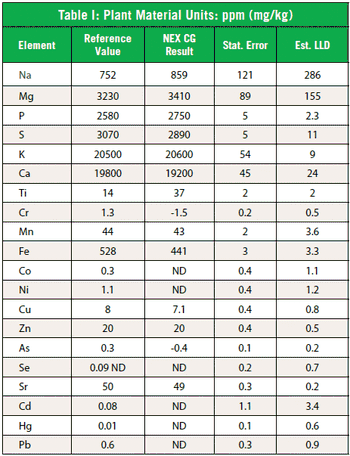
In the agri-food sector it is important to not only study the soil composition and use of fertilizers, but also the uptake of nutrients and potentially toxic elements within the plants and crops themselves.
Application Notebook
In the agri-food sector it is important to not only study the soil composition and use of fertilizers, but also the uptake of nutrients and potentially toxic elements within the plants and crops themselves.
Application Notebook
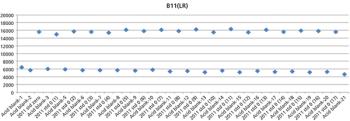
Elemental ratio determinations in foraminiferal calcite require the measurement of trace levels of Na, Mg, Sr, and ultra-trace levels of Li, B, Ba, Cd, Mn, U in a calcium rich matrix and ratioed to calcium.

Spectroscopy
In gemology the TSI ChemReveal LIBS Desktop Analyzer has been used to aid gemologists in gemstone classification. This paper highlights study results of this instrument in some of those applications.

Spectroscopy
Peak emission for silicon occurs at values beyond the range of sensitivity for silicon-based detectors, like CCDs. EMCCDs combine a larger field of view and higher resolution with high sensitivity in the NIR at lower cost.
Application Notebook
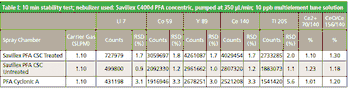
The new Savillex PFA Cyclonic Spray Chamber is the first inert chamber with the traditional shape of a glass cyclonic, and is also the first translucent inert chamber.
Application Notebook
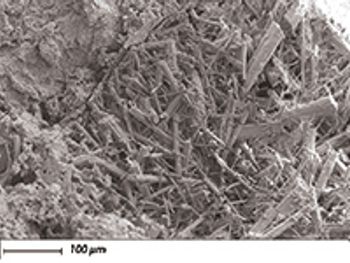
Ancient Roman builders designed maritime concrete harbor structures to remain intact in the aggressive seawater environment for very long periods of time.
Application Notebook
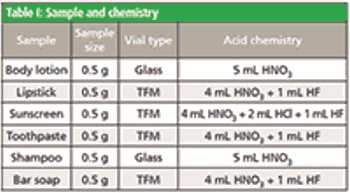
Milestone's UltraWAVE microwave digestion system with single reaction chamber (SRC) technology, enables the simultaneous digestion of up of to 22 different sample types and chemistries at temperatures and pressures as high as 300 ?C and 199 bar.
Application Notebook
The permitted sulfur limit in fuel oils has been decreased to 10 ppm in many regions.
Application Notebook
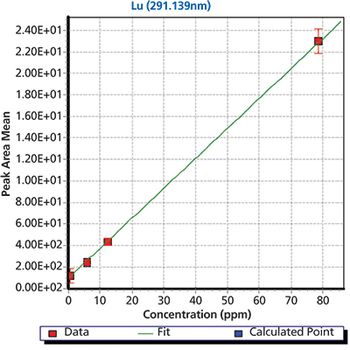
The lanthanide series is a series of metallic elements, with atomic numbers 58 through 71, which are - in order of increasing atomic number - cerium, praseodymium, neodymium, promethium, samarium, europium, gadolinium, terbium, dysprosium, holmium, erbium, thulium, ytterbium, and lutetium.

Application Notebook
The new Savillex C400d PFA concentric nebulizer for ICP-MS combines the reliability of a low flow glass nebulizer with the chemical resistance and low elemental background of a PFA concentric nebulizer.
Application Notebook
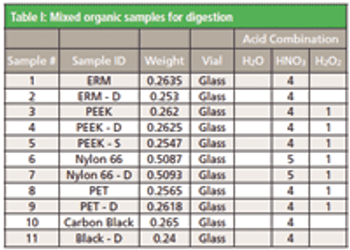
Sample matrices with high organic content have created a significant challenge for sample preparation methods.
Application Notebook
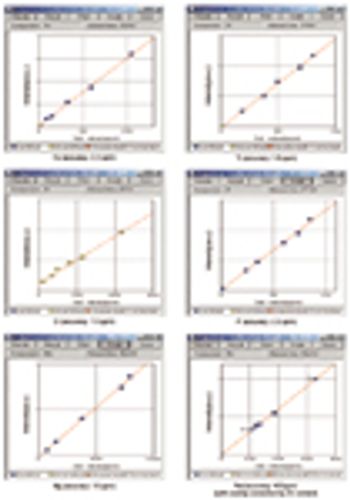
This application note introduces an Application Package for quantitative analysis of additive elements in polymer.

Application Notebook
This application note describes the capability of the Teledyne Leeman Lab's Prodigy7 High-Dispersion ICP for performing analysis according to SW-846 Method 6010C.
Application Notebook
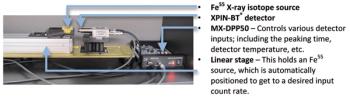
Moxtek now has a full energy dispersive X-ray fluorescence detector solution with Moxtek's XPIN detectors and our new MXDPP-50 electronics.
Application Notebook
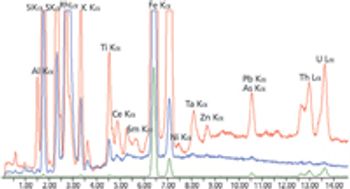
Demonstration of the advantages of using the Orbis micro-XRF elemental analyzer rather than other analysis techniques to perform elemental analysis through a plastic barrier and/or at atmospheric pressure.
Application Notebook
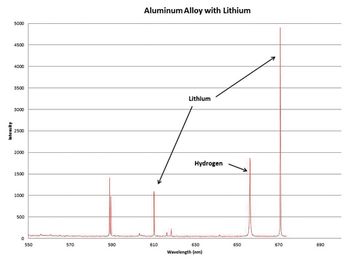
SciAps has developed a handheld analyzer based on laser induced breakdown spectroscopy (LIBS).
Spectroscopy
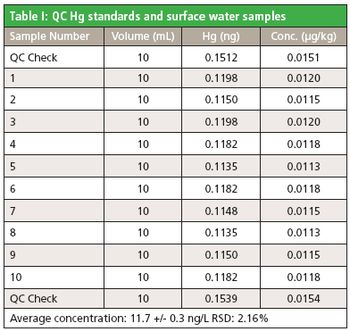
With over 1300 commercial testing labs in the United States, one out of every three samples is for water analysis. There has been an even stronger emphasis on mercury testing and its concentration in our water supplies.
Application Notebook
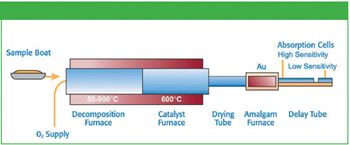
Mercury is a toxic, persistent pollutant found in many native ores rich in copper, silver and gold. As such ores are processed mercury can be released to the environment.
Application Notebook
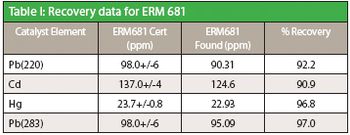
Single reaction chamber microwave digestion enables a chemist to digest up to 15 different specialty chemical samples simultaneously at temperatures as high as 300 ?C, greatly simplifying the workflow while maintaining superior quality digestions.
Application Notebook
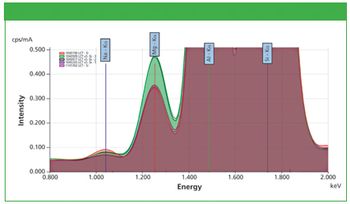
The analysis of coal is demonstrated, with specific emphasis on the measurement of Na2O, using a Cartesian geometry energy dispersive X-ray fluorescence (EDXRF) spectrometer employing the Fundamental Parameters (FP) approach.
Application Notebook
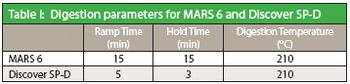
Pharmaceutical samples spiked with several heavy metals were prepared for ICP-MS analysis using microwave digestion following the protocols in proposed USP chapters <232> and <233>. The results of the spike recovery study are discussed.
Application Notebook
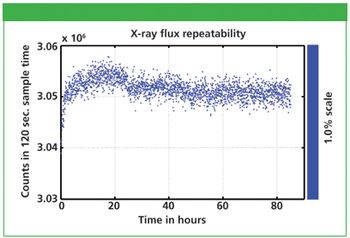
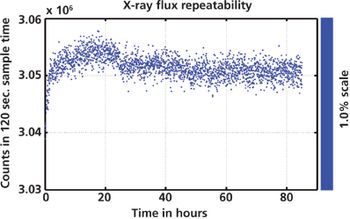
Moxtek's ULTRA-LITE X-ray source is a very small self contained X-ray source (X-ray tube and high voltage power supply) for use in portable X-ray applications, such as the handheld X-ray fluorescence (XRF) spectrometers. This note demonstrates that this X-ray source has a stable and repeatable X-ray flux output over time, which is vital for the precision of the calibrated XRF measurements.
Application Notebook
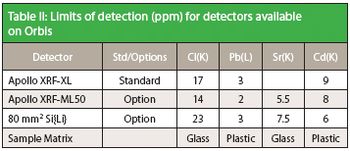
The measurement of trace elements is important across a wide variety of materials characterization problems. When measuring small glass fragments collected from crime and accident scenes, forensics experts analyze trace strontium (Sr) and zirconium (Zr) typically unintentionally incorporated into the glass during manufacturing as one point of identification or comparison.
Application Notebook
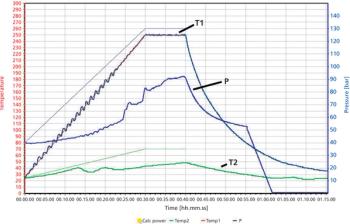
Single reaction chamber (SRC) microwave digestion offers multiple benefits over traditional dry ashing for the sample preparation of heavy crude oils for trace metals analysis. These include increased sample throughput, reduced risk of contamination, more complete digestion and retention of volatile analytes.
Application Notebook
Moxtek's ULTRA-LITE X-ray source is a very small self contained X-ray source (X-ray tube and high voltage power supply) for use in portable X-ray applications, such as the handheld X-ray florescence (XRF) spectrometers. This note demonstrates that this X-ray source has a stable and repeatable X-ray flux output over time, which is vital for the precision of the calibrated XRF measurements.
Application Notebook
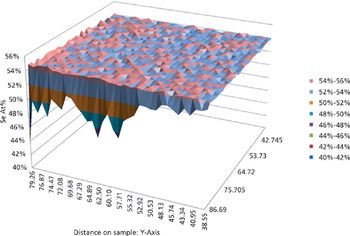
Building on more than 10 years of Micro-XRF experience, the Orbis spectrometer yields a system with excellent Micro-XRF capability while setting a new standard in analytical flexibility. The Orbis incorporates a unique motorized turret integrating video and X-ray optics allowing coaxial sample view and X-ray analysis. The turret can accommodate two additional collimators along with the X-ray optic for a total of three X-ray beam sizes to expand the Orbis analytical capabilities beyond traditional Micro-XRF analysis.
Application Notebook
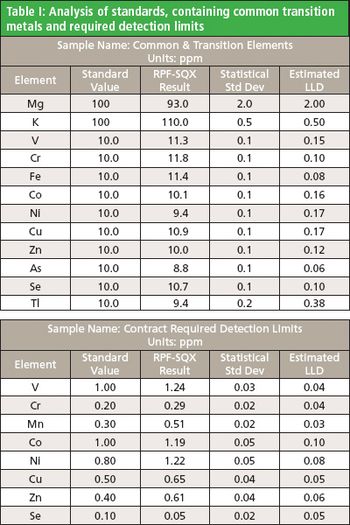
Elemental analysis of aqueous solutions into the low ppm and sub-ppm concentration ranges is demonstrated, using the advanced Cartesian geometry Rigaku NEX CG Energy Dispersive X-ray Fluorescence (EDXRF) spectrometer in conjunction with the patented UltraCarry? sample preparation technique.
Application Notebook
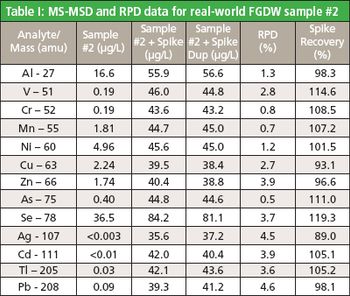
The US EPA wrote wastewater effluent limit guidelines for discharge permits granted to coal-fired power plants back in 1982, known as 40 CFR Part 423. However, the rule has not kept pace with changes in the industry over the past several decades. For that reason, the US EPA has revised the rule with new proposed revisions expected in November 2012 and the final rule expected by April 2014. To support the modification to this rule, the US EPA is developing a new ICP-MS method specifically for flue gas desulfurization wastewaters (FGDW).
Application Notebook
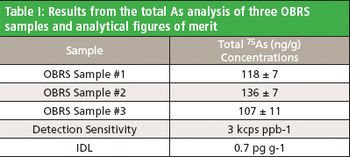
This paper demonstrates an ICP-MS method for the determination of total and As species concentrations in organic brown rice samples (OBRS).