
Raman Spectroscopy

Latest News


Special Issues

Carbon nanotubes are unique nanostructures with remarkable mechanical and electrical properties. Due to their tremendous potential for future innovations, great efforts are made to characterize these structures. In the following study, carbon nanotubes were investigated with Confocal Raman Microscopy and Atomic Force Microscopy using only one single instrument.

Spectroscopy

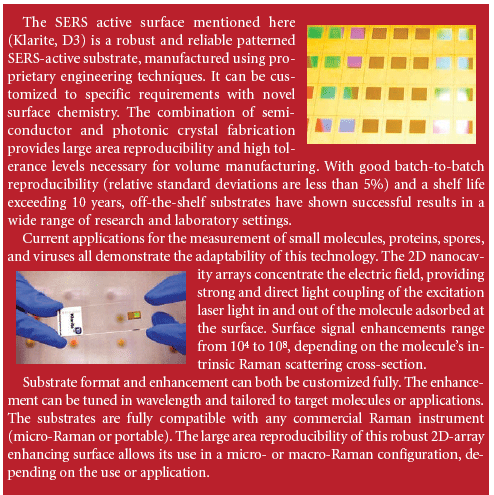
Surface-enhanced Raman spectroscopy (SERS) is a widely studied technique capable of adding single-molecule detection capability to the rich information provided by Raman spectroscopy. in this aricle, the authors show an additional system gain of more than two orders of magnitude to SERS by using a dielectric microsphere resonator to capture and excite the target system.

i3_t-166441-1408697965336.jpg

Special Issues

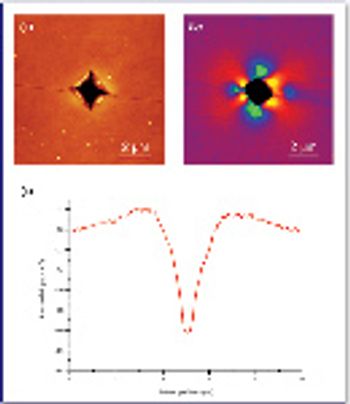
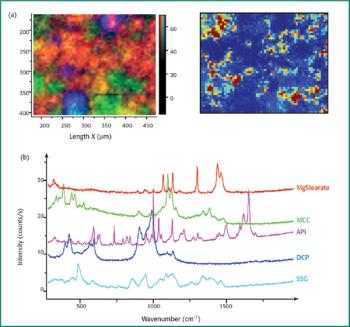
Confocal Raman microscopy can be useful when applied to all samples that are heterogeneous on the micrometer to millimeter scale and that generally can be investigated by Raman spectroscopy. This article presents examples of confocal Raman microscopy from various fields of application including pharmaceutical analysis and stress measurements in semiconductors.

i3-166465-1408697924825.gif

Special Issues

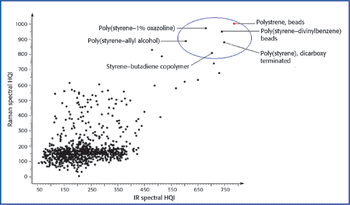
A new system for multitechnique spectral searching is described that utilizes analysis of several hit lists resulting from spectral similarity searches performed simultaneously in reference databases for multiple complementary analytical techniques. This paper demonstrates the benefits of this multitechnique approach using the complementary techniques of IR and Raman spectroscopy.

i4-166435-1408697979638.gif

Special Issues

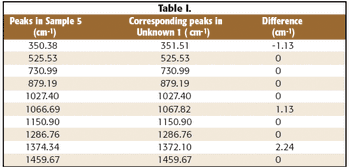
The authors present a novel technique for obtaining very high stability and reproducibility of a Raman spectrum, using grating corrected laser stabilization. An externally stabilized laser with a grating spectrometer provides exceptional quantum efficiency in the entire dynamic range. These components then are used to build a library of pharmaceutical raw materials and tested on samples of unknown material.

i4-166430-1408697985664.jpg

Special Issues

Raman spectroscopy has been employed to detect Bacillus cereus spores, an anthrax surrogate, collected from a letter as it passed through a mail sorting system. Raman spectroscopy also has the ability to identify many common substances used as hoaxes. A three-step method also is described for the detection of dipicolinic acid extracted from surface spores by SERS.

Special Issues

The authors show how a multivariate curve resolution algorithm, called SIMPLe-to-use Interactive Self-modeling Mixture Analysis (SIMPLISMA), can facilitate the quantitative and qualitative analysis of difficult samples, and apply the algorithm to a technically challenging Raman spectra series for carbamazepine polymorphs.