



Spectroscopy
A few key steps will protect your samples and help ensure accurate results.
Spectroscopy
A few key steps will protect your samples and help ensure accurate results.
Spectroscopy
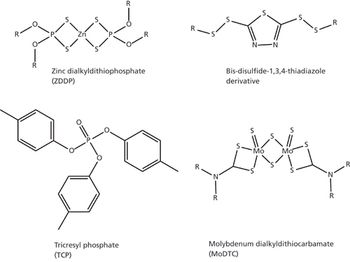
Developments in lasers, detectors, low-cost instruments, and fiber-optic probes have greatly expanded the lubrication systems being studied by Raman spectroscopy.
Spectroscopy
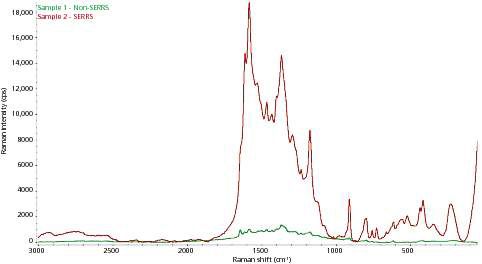
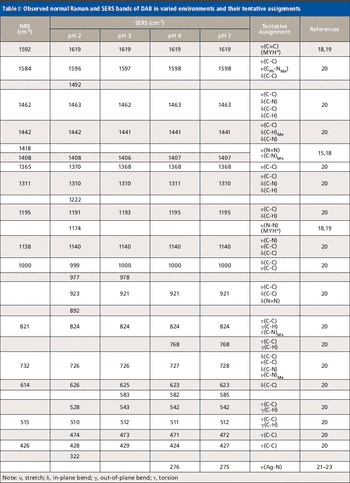
Surface plasmon resonance, charge-transfer resonance, and their combination determine the enhancement of surface-enhanced Raman scattering signals, and the varying intensities of the signal at different pH levels may result from the change in contributions of the combined system.
Special Issues
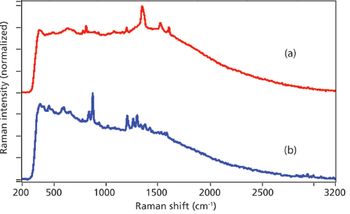
A portable Raman analyzer with laser excitation at 1550 nm provides "eye-safe" explosives detection.
Special Issues
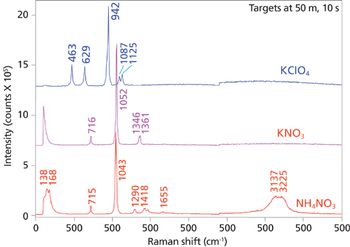
A compact standoff Raman system can be used to detect hazardous chemicals and chemicals used in homemade explosives synthesis.
Spectroscopy
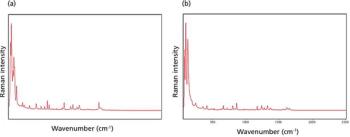
Spatially offset and transmission Raman spectroscopy enable chemical characterization of diffusely scattering samples at depths not accessible by conventional Raman methods.

Spectroscopy
Raman spectroscopy can be used to measure the vibrational spectra of both organic and inorganic materials.
Spectroscopy
Graphene has potential applications ranging from computer monitors to solar cells, and Raman spectroscopy is a useful method for its characterization.
Application Notebook
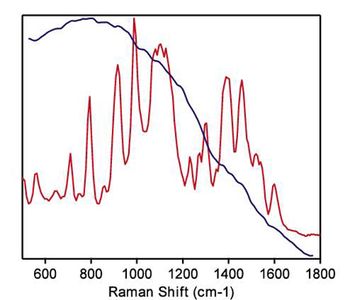
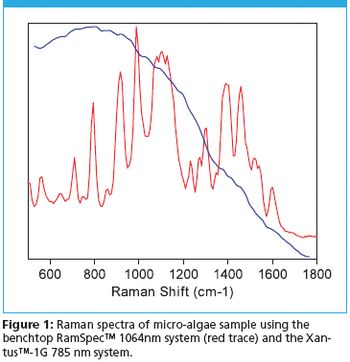
BaySpec, Inc. has developed a complete line of 1064 nm excitation, dispersive Raman systems that offer maximum reduction in fluorescence interference from biological samples and thus making them very useful tools for biofuel research.
Application Notebook
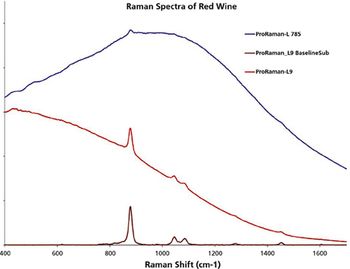
In recent years, the spectroscopy community has observed rapid development of Raman instrumentation and its usefulness in a variety of applications. Routine Raman analysis with 785 nm excitation has served well for the great majority of industrial applications and has become the most favored instrument configuration.
Spectroscopy
Virtually everything we know about stars is based on spectroscopy, including what we know about magnitude, red shift, and why the night sky is dark.
Spectroscopy
This month's column discusses the various multiphoton spectroscopy techniques and the lasers required for each approach.

Application Notebook
For the characterization of the properties of a sample with Raman spectroscopy, an ultrasensitive confocal Raman microscope allows the acquisition of a Raman image stack revealing 3-D information on the distribution of the chemical compounds.

Application Notebook
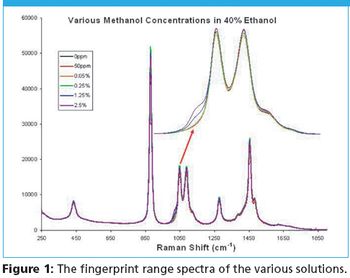
Low concentration natural methanol exists in most alcoholic beverages and usually causes no immediate health threat.
Application Notebook
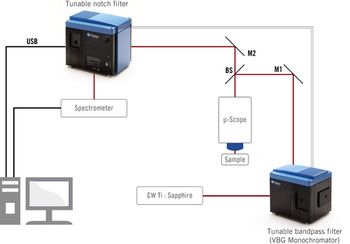
Photon etc. has designed two narrowband tunable filters for resonance Raman spectroscopy.
Special Issues
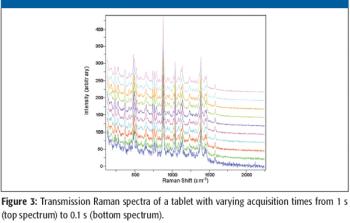
The motivation for the development of an instrument for transmission Raman measurements is described. The basic instrumentation and the first results from a commercial system are provided. Transmission Raman spectroscopy (TRS) performance is compared to and contrasted with that of a confocal Raman microscope.
Special Issues
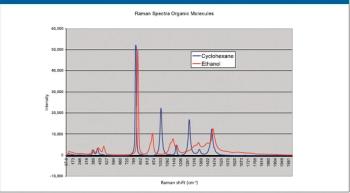
Recent developments in photonics are finally making Raman instrumentation accessible to larger basic laboratories.
Special Issues
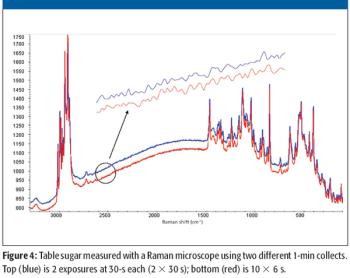
Today's Raman spectrometers are more capable than ever before. The seeds of innovation in filter, laser, and CCD technology have produced a crop of instruments that are fast, sensitive, and robust. This is good news because scientists are constantly bombarded with challenging problems that require the top performance from their instruments.
Special Issues
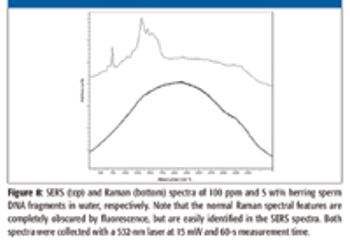
Surface-enhanced Raman spectroscopy (SERS) has been studied extensively over the last few decades with many advances in preparation of SERS substrates and coatings. While the bulk of the research in SERS substrate preparation has been devoted to pushing detection limits to higher sensitivity for measurement of single samples, the application of SERS to high-throughput analysis has been largely ignored. In this article, we present the use of commercially available SERS-coated microtiter plates in a dedicated Raman microtiter plate reader, enabling high-throughput trace analysis measurements. This article also describes the SERS substrate, the high-throughput plate reader, and preliminary results from samples representing trace analysis of explosives, nerve agents, pharmaceuticals, and biological compounds.
Special Issues
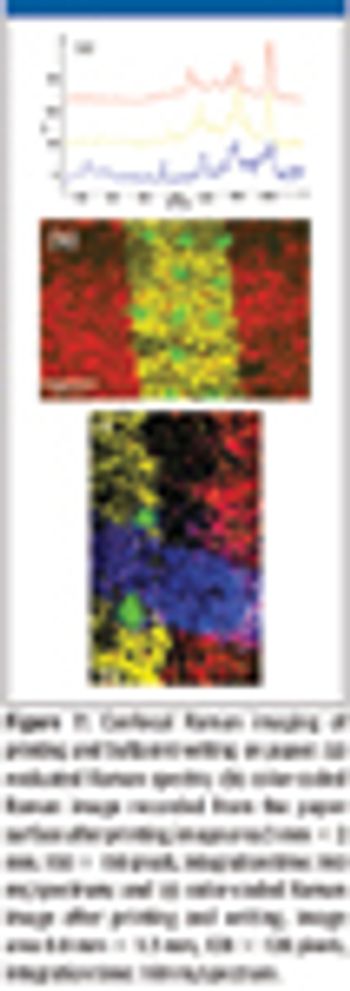
A better understanding of the micro- and nanostructures of cellulose fiber composition before and after various chemical treatments, together with the distribution of bleaching additives to the final paper composition, is essential for further improvements of paper properties. Confocal Raman imaging is a valuable tool for such studies, as it reveals not only optical information but also information regarding the 3D distribution of the chemical compounds in the submicrometer range. In the paper surface finishing process, additional surface roughness parameters can be measured by combining confocal Raman microscopy with atomic force microscopy. Such combined analytical microscopes allow a direct linking between high-resolution imaging and chemical identification of various species on a surface.
Special Issues
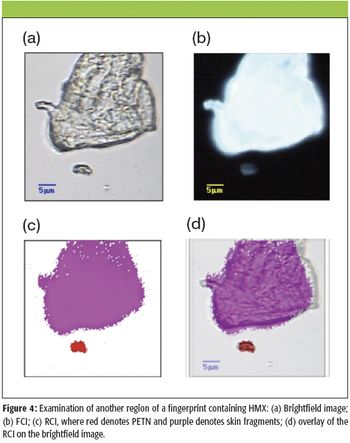
The use of explosive devices by terrorist groups has become a constant threat in recent years. Because of this threat, the U.S. Army and other organizations are developing spectroscopic techniques to detect explosives and perform forensic examination of scenes where explosives were handled. In our group, Raman chemical imaging (RCI) is being used for forensic examination of latent fingerprints contaminated with traces of explosives. RCI has the potential to be a powerful technique both for detecting explosives and providing the biometric information necessary to identify individuals who have handled explosives.
Special Issues
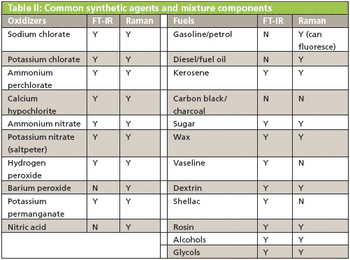
Interest in vibrational spectroscopy, principally Raman and mid-IR (FT-IR) continues to increase as these analytical techniques may be applied to a wide variety of fields, including the safety/security sector. Raman and FT-IR have seen rapid deployment for use in homeland security applications, largely due to the high chemical specificity which allows robust identification. In this article, we discuss the application of the latest portable, rugged Raman and FT-IR handhelds, enabling robust identification of explosives, TICs, TIMs, and narcotics in the field. This article introduces explosives, their different classes, and the applicability of Raman and FT-IR spectroscopy to identify their components (commercial, HMEs, and IEDs) or precursors.
Special Issues
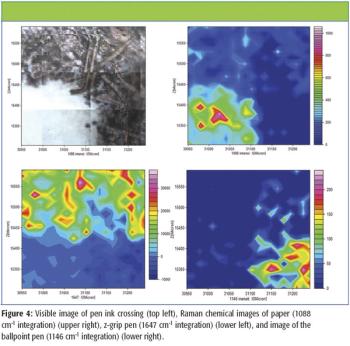
Documents have been investigated to determine the feasibility of utilizing Raman and SERS Raman spectroscopy for the identification and characterization of inks on paper. Fluorescence reduction methods have been employed to facilitate the analysis by reducing the nascent fluorescence from paper and ink. Furthermore, ink crossings were investigated to demonstrate that ink applied after creation of a document could be differentiated from the originally applied ink.
Application Notebook
BaySpec, Inc. has developed a complete line of 1064 nm excitation, dispersive Raman systems that offer maximum reduction in fluorescence interference from biological samples and thus making them very useful tools for biofuel research.
Application Notebook
Low concentration natural methanol exists in most alcoholic beverages and usually causes no immediate health threat.