
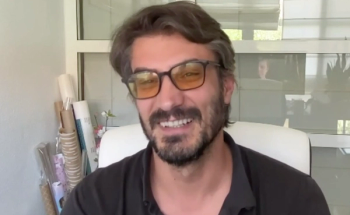
In this interview segment, Leo Gkouvelis of Ludwig Maximilian University discusses the opposition surge effect and how his study explored a new method for modeling the opposition surge effect in studying exoplanets.
In this interview segment, Leo Gkouvelis of Ludwig Maximilian University discusses the opposition surge effect and how his study explored a new method for modeling the opposition surge effect in studying exoplanets.

This year, the SciX Conference will take place at the Northern Kentucky Convention Center in Covington, Kentucky, from October 5–10, 2025

A recent study provided new information on how berberine mid-chain fatty acid salts interact with lysozyme.


A recent study investigated the deterioration mechanisms of rammed earth materials from the UNESCO World Heritage Pingyao Ancient City walls.

This explainer video highlights how nuclear magnetic resonance (NMR) spectroscopy is being used to improve the evaluation of vegetable oil quality.
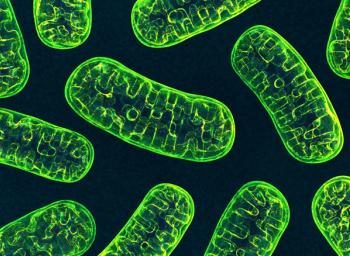
A recent study tested a new mitochondria-targeting fluorescent probe, known as Mito-CDM, to see if it can improve the monitoring of mitochondrial viscosity.

This explainer video describes the role that reflection and emission spectroscopy play in characterizing rocky exoplanets.

This explainer video highlights how energy-dispersive inelastic X-ray scattering (EDIXS) can be used to discriminate between different stamps.
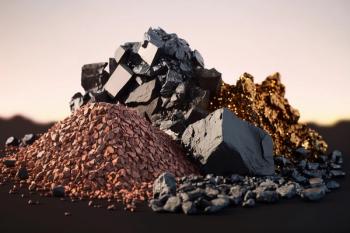
A recent study conducted by researchers from Northwestern Polytechnical University explored how to improve laser-induced breakdown spectroscopy (LIBS) for analyzing complex mineral samples


The Winter Conference on Plasma Spectrochemistry will convene in Tucson, Arizona, from January 11–17, 2026.
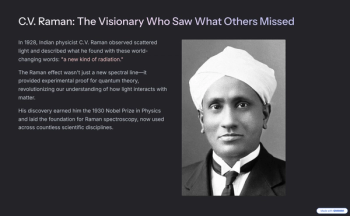
The Icons of Spectroscopy series shines a spotlight on the pioneers whose work laid the foundation for modern analytical science.
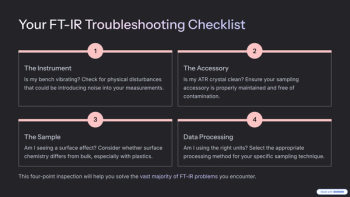
Learn how to troubleshoot FT-IR spectroscopy. From noisy spectra to ATR errors, discover four common FT-IR problems and simple fixes.

This explainer video highlights how spectroscopic sensors can help improve health monitoring applications.

This explainer video highlights how spectroscopy is being integrated with artificial intelligence to improve detection accuracy of microplastics.
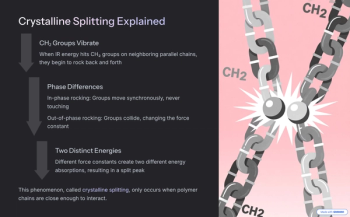
Why polyethylene’s IR spectrum splits—unveiling crystallinity, side chains, and polymer structure in HDPE, LDPE, and LLDPE.

Spectroscopy is increasingly being used in cultural heritage studies. We discuss spectroscopy's evolution in this field.

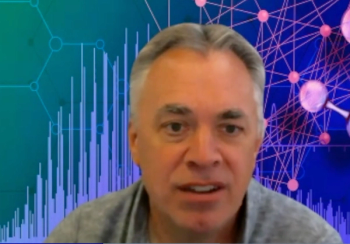
In this interview segment, Robert Ewing discusses how his contactless method improves on traditional drug detection techniques and how the VaporID technology remains adaptive to emerging synthetic variants.
Top articles published this week include an interview series with Robert Ewing of the Pacific Northwest National Laboratory, a news article on using infrared (IR) cameras to see invisible methane leaks, and an article about the role of vibrational spectroscopy in analyzing plant-based food products.
In Part II of our three-part interview with Robert Ewing, he reviews the results of the Nogales border test.
Experts explore the evolving role of CDMOs in semiconductor fabrication and why strategic partnerships are increasingly critical for process innovation and cost control.
Looking ahead, panelists discuss emerging technologies, new analytical frontiers, and future regulatory pressures shaping semiconductor manufacturing over the next decade.
The panel takes a deep dive into total chemical and gas management (TCGM) strategies, and the growing need for online, real-time monitoring to protect yield and safety.
Panelists discuss cutting-edge advances in monitoring ultra-pure water (UPW) purity, from ICP-MS to online pre-concentration, and the growing push for sub-ppt-level contaminant detection.
The panelists discuss the vital role of ultra-pure water (UPW) and recycled water strategies to support yield, safety, and environmental compliance.
The panel discusses how silicon (Si), silicon carbide (SiC), and gallium nitride (GaN) materials influence semiconductor design choices, yield challenges, and supply chain risks.
This episode takes a look at the evolving regulatory environment in semiconductor manufacturing, including stricter contamination standards and the challenges of global compliance.
The panelists consider non-destructive wafer analysis using TXRF and complementary methods, and how combining techniques enables advanced defect and contamination mapping.