



Special Issues
Back by popular demand, Spectroscopy's resident MS expert, Ken Busch, presents a list of common acronyms used in the field.
Special Issues
Back by popular demand, Spectroscopy's resident MS expert, Ken Busch, presents a list of common acronyms used in the field.
Special Issues
The author reviews the Digital Library for the Analytical Sciences (ASDLib) Web site, its philosophy, a summary of its MS resources, and how it can be useful to mass spectrometry practitioners.
Special Issues
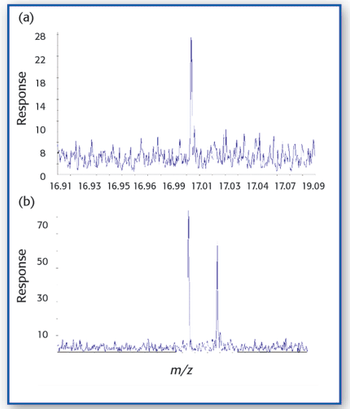
A transportable miniature Fourier-transform ion cyclotron resonance mass spectrometer is used to identify chemical species and remove isobaric interferences in gas analysis. Experimental results use real time direct analysis without the need for additional separation.

Special Issues
The annual event will continue its tradition of promoting knowledge of all things mass spectrometry, with a few new features mixed in.

Special Issues
The European-built Huygens probe made history on January 14 by becoming the first spacecraft to land on Saturn's largest moon. The Huygens gas chromatography–mass spectrometry team concluded that methane rain occurs on the moon, and GC–MS can distinguish between two isotopic forms of carbon — carbon-12 and carbon-13. By comparing the carbon-12/13 ratios it might be possible to pin a biological source to the methane arising from the interior of Titan.
Special Issues
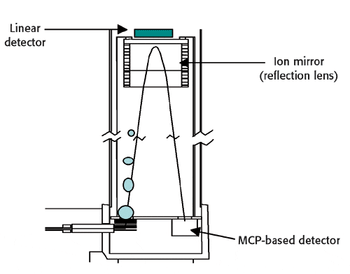
Time-of-Flight (TOF) is rapidly becoming the most popular method of mass separation for proteomics and conventional analytical chemistry. The development of very high temporal resolution ion detectors and low-cost high-speed digitizers has rendered this technique easily deployed and able to produce very high mass resolution. The performance of a TOF mass spectrometer is dependent upon a number of critical components. This article will focus on the ion detector.
Special Issues
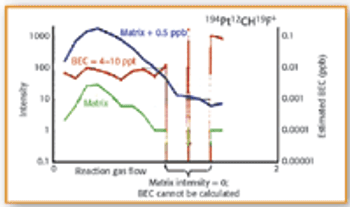
The potential for signal drift, matrix suppression, and spectral interference, in addition to demanding sample preparation, can make geological matrices some of the most difficult to analyze by conventional inductively coupled plasma-mass spectrometry.
Special Issues
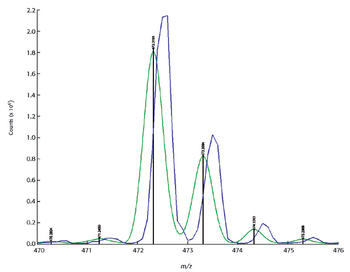
The exploding field of proteomics has highlighted the need to improve the performance of mass spectrometry, both quantitatively and qualitatively. These needs have led instrument manufacturers to produce instruments of increasingly higher quality, but little work has been done to address the fundamental errors inherent in the measurement technique itself. This paper examines these errors and demonstrates that the appropriate mathematical correction of MS data can significantly improve the performance of both low- and high-resolution instruments.

Special Issues
Off-line 2-D LC–MS-MS represents a powerful alternative to on-line methodologies for protein identification from complex proteomes, improving the chromatographic resolution of digest peptide mixtures, even for low-abundance proteins. Here, the authors provide a detailed comparison of the two techniques.
Spectroscopy
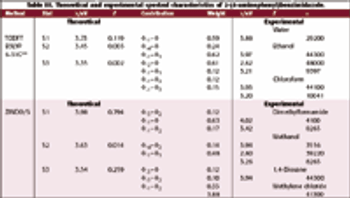
Time-dependent density functional theory and ZINDO/S methods have been used to compute and analyze the electronic spectra of benzazoles, 2-phenylbenzazoles, and 2-(4-aminophenyl)benzazoles. The observed spectra of the studied antitumor drugs are diffuse and highly solvent-dependent. Spectral analysis of the charge density distributions and relative polarities of the ground and excited states have enabled understanding of the observed solvent effects.
Spectroscopy
Spectroscopy is proud to present its annual review of products displayed at our industry's premier trade show, the Pittsburgh Conference. The Spectroscopy editorial staff spent a good portion of the show investigating and collecting information on exhibitors' offerings, and a sampling of those instruments appear below, including a brief product description and the company's name and Web address. We have made every effort to provide as comprehensive a listing as possible, but as in years past, we cannot claim to have made a complete record of every product shown at the conference.
Spectroscopy
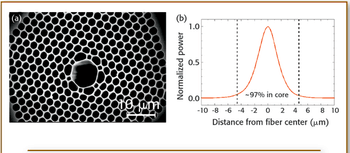
Photonic crystal fibers are novel optical waveguides that offer promising alternatives for various sensing applications. This article describes an experiment in which the absorption spectrum of acetylene was measured to demonstrate the effectiveness of photonic bandgap fibers for high sensitivity gas detection. Methane also was studied to determine the same capability in weakly absorbing gases.
Spectroscopy
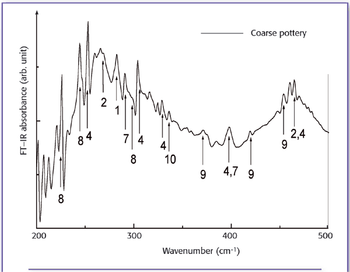
The authors describe their work characterizing archaelogical ceramics by means of Fourier-transform infrared (FT-IR) absorption. Semiquantitative analyses using the technique can identify the main components and trace elements constituting the ceramics. An accurate knowledge of the chemical composition of the samples gives useful information for their classification.
Spectroscopy
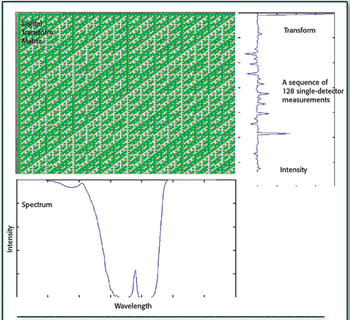
MEMS are small, microfabricated devices that are finding application in a variety of industries in both analytical and manufacturing settings. This paper reviews the properties of diffractive MEMS devices and examines their application in chemical spectroscopy.
Spectroscopy
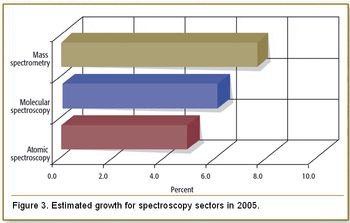
Overall, 2004 was a good year for the laboratory analytical and life science instrument industry. A rebound in industrial demand, steady increases in life science spending, and strong growth in Asia and North America drove instrument systems and aftermarket sales. Similar to last year, 2005 should bring healthy sales growth as many of the end-market and regional drivers of last year continue to fuel demand.
Spectroscopy
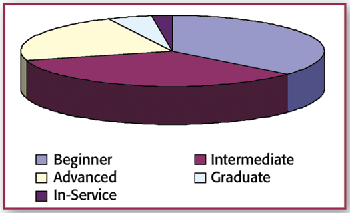
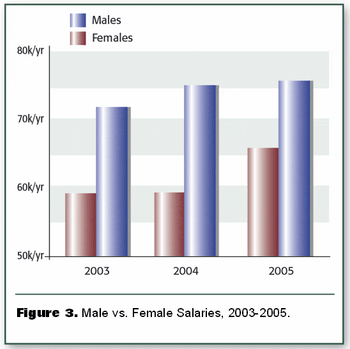
Spectroscopy's annual look at practiitioners' incomes and attitudes about their jobs finds that both have improved modestly in the face of challenging economic and employment conditions.
Spectroscopy
The author discusses an instrument called SEARCH (Scan for Extinct Astrobiological Residues and Current Habitats) designed for use on NASA Mars rover missions.
Spectroscopy
The authors present an MS technique that reliably detects several types of fungal mycotoxins, and compare electrospray ionization and atmospheric chemical ionization techniques.
Spectroscopy
The authors describe implementation and performance of a miniaturized NIR analyzer and associated chemometric techniques applied to the monitoring of a drying process for active pharmaceutical ingredients (APIs).
Spectroscopy
This article introduces the application of high-resolution ultrasonic spectroscopy for the analysis of emulsions and suspensions.
Spectroscopy
This article provides an overview of several recently developed technologies that will improve the utility and performance of mass spectrometers in a number of applications.
Spectroscopy
The authors describe an ICP detection technology that combines photo-current conversion and a solid-state multichannel detector.
Special Issues
The need to verify cleaning between manufacturing runs presents a special challenge to the analytical chemist. In this article, the principles of ion mobility spectrometry are described, its performance is compared to HPLC for the analysis of cleaning validation samples, and findings are presented from a study to establish the feasibility of using IMS in validating a cleaning verification method.
Special Issues
A majority of current discussion about NIR's applicability to pharmaceutical manufacturing is focused on preparative processes such as granulation, drying, and blending. The author examines different considerations for NIR for the output of the manufacturing line - finished tablet analysis.